The Catacombs: Dawn in the Dark
Beneath the city of Rome there is what might be called a holy ghost town rich with sacred memory—the catacombs. This labyrinth of now empty tombs, its walls adorned with poignant sacred art, stands as a testament to the devotion of Rome’s early Christians.
Transcript
Read the full transcriptAuto-generated · 1,258 words
Rome. They call it the Eternal City, but its true eternity is rooted in the darkness, meters beneath the asphalt we tread every day. Here lies a labyrinth of silence and history, over 60 catacombs circling the city like a subterranean crown.
Let's dispel a legend right away. These were not secret hideouts for fugitives. They were immense cities of repose, known to all, where the early Christian community carved into the tuff its hope for life beyond death. Before entering the heart of our journey, we must honour a hidden jewel.
On the Via Casilina lies a magnificent and unknown wonder, the catacombs of St. Marcellinus and Peter. They call them the underground art gallery for the richness of their frescoes. But their importance goes beyond art. It is here that the Emperor Constantine erected the majestic mausoleum for his mother, St. Helena. She, the archaeologist empress, the woman who dedicated her life to seeking the traces of Christ, and became the guardian of the memory and relics of the Passion. Helena wished to rest here, among the martyrs, sealing forever the bond between the power of the Empire and the faith of the early Christians.
But there is another place, on the Via Salaria, that holds a different distinction, not an imperial one, but one of intimacy and origins. It's in the catacombs of Priscilla that Christian art took its very first steps. Let's descend into the dark with Monsignor Pasquale Iacobone, President of the Pontifical Commission for Sacred Archaeology, to decipher this secret language. We are on the Via Salaria, one of the great consular roads of Rome, and here stands one of the first, most ancient catacombs of Rome, one of the cemeteries of the Christian community.
That of Priscilla. She was likely the noblewoman who owned this land, and made this site available to the Christian community, specifically for burials. It is a place particularly dear to me, because here we have the first Christian representations, especially the Marian ones. And so, I invite you to take this journey with me.
After crossing a corridor that leads us across the Salaria, here we are beneath a villa, one of the great villas of Rome. And it is here that the actual catacomb winds its way, carved from the typical Roman tuff, the pozzolana, with this reddish color. So we begin to see the galleries with the loculi, the tombs lining the entire path.
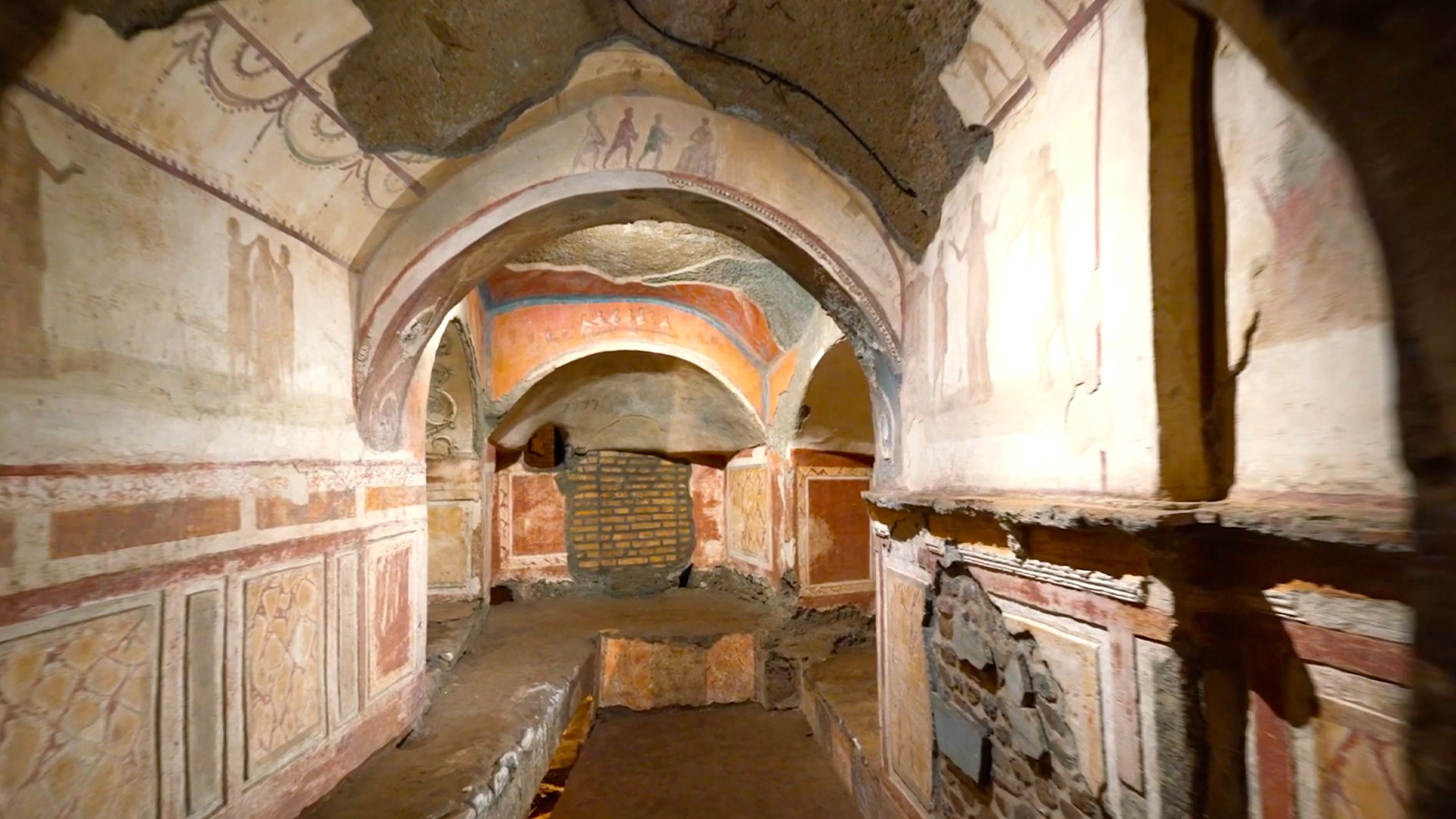
The tuff, the volcanic stone upon which history rests, is not just earth, it's the very skin of Rome. Banish the idea of a macabre place, this is the Sistine Chapel of the Origins, the cubiculum of the veiled woman. Here, art does not serve to decorate, but to cry out that death is not the end. The first stop on the path in the catacombs of Priscilla is here, at the so-called cubiculum of the veiled woman.
A decoration that is among the first in Christian art. We are at the beginnings, the very first years of the 3rd century. It opens with the image of Jonah on the entrance arch. Jonah, rejected by the sea monster, is one of the most frequent images in the catacombs, referring to the resurrection of Christ. At the back, there is a familiar scene in the centre, a beautiful image of a woman in prayer.
The woman raises her hands in a gesture of victory. Around her, her earthly life and the great challenges of faith. Powerful imagery for the early Christians who risked martyrdom. A life marked above all by two moments. The first, looking to the left, marriage. And then, on the right, the scene of motherhood. This family history is inserted into a history that is the history of salvation.
Marked by historical moments narrated in the Old Testament. So, we have on the left the scene of Abraham taking Isaac up the mountain to sacrifice him, but then he is saved by God, who stops the gesture of sacrifice. Just as on the right, the three young men in the fiery furnace, condemned to death by Nebuchadnezzar, but who escape. Saved from the violence of the fire and live, they survive martyrdom. And so, two moments of salvation are celebrated to remember that here one sleeps, one rests awaiting salvation, the final liberation.
And so, in a cemetery, a place of death, here salvation and life are celebrated. But it's by continuing into the shadows that Priscilla reveals her greatest secret, an absolute first in the history of humanity. In a hidden corner, 1800 years ago, someone lit a light that has never been extinguished.
We are at the second stop of the journey inside the catacombs of Priscilla, and it is perhaps the most beautiful, the most evocative, because here, raising our eyes to the vault of the gallery, we find ourselves in front of the first image of the Madonna and Child. The absolute first in history. One notices, first of all, a male character portrayed standing, but making a particular gesture with his right hand, and his index finger points us to a spot, but representing a star, and the figure inevitably reminds us of a prophet.
The star signifies the Messiah, the coming of the Messiah. Beneath that star, here is depicted this seated woman holding a child to her breast. It seems she is nursing him, and then, at a certain point, almost solicited by our presence, the child turns, turns his head towards us and looks at us, and has these sharp little eyes that fix upon us, and it is the representation of the history of salvation. Right here, In this place so dark, so gloomy, we have a symbol of light, a star, the only true star that illuminates our path, our existence.
From contemplation to action. In the Greek chapel, art becomes cinema. The figures are not static, they run. It's the pilgrimage of all humanity. The first scene is one of the first, if not the first, depiction of the adoration of the Magi. We have these three characters, painted each in a different colour, green, white, red. The three characters refer to the three great lineages, and therefore to all humanity, to all cultures. All humanity runs towards Christ. It is remarkable that in a catacomb, in a cemetery where everything is motionless and still, There is such a dynamic representation.
Death does not stop the journey, the pilgrimage of man, of humanity. But beyond death, we are invited to walk, to run towards Christ. Priscilla is not just art, it's the cradle of spiritual authority. Here, before the glory of St. Peter's, the popes were buried. A place of memory, saved from oblivion.
Coming back up from the cemetery galleries, we arrive in the Basilica of San Silvestro, built right over the tomb of Pope Sylvester. But here we have the epitaphs that remember the other pontiffs laid to rest in the catacomb. Pope Marcellus, Pope Celestine, Pope Siricius, and then the martyrs Felix and Philip. And therefore, a place particularly important for the history of the Christian community of Rome.
Emerging back into the sunlight after this journey feels different. We walked among tombs, yet we did not encounter death. We saw colors, mothers, running, banquets. The message, etched in the red tuff, is clear. For those who painted these walls, the darkness was not the end. It was only the wait for the dawn. From underground Rome, this is the secret language of faith.