Is Children’s Television Quietly Frying Our Kids' Brains? | The Deep
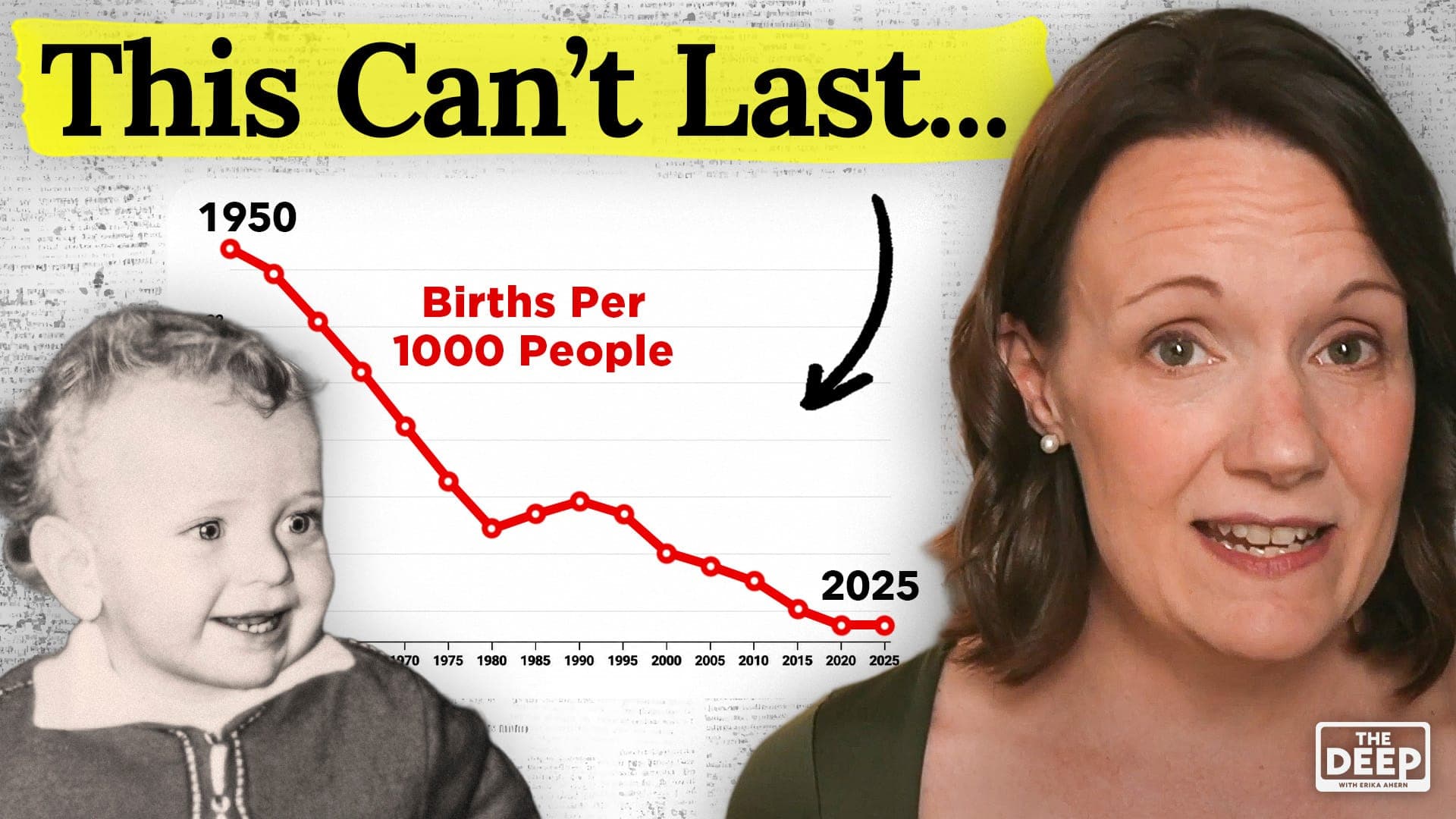
Elmo didn't always act like... well, Elmo. So what happened? From Sesame Street to Cocomelon, the fight for children's attention transformed kids' TV into a high-speed sensory experience. In this episode of The Deep, Erika dives into surprising research that may change how you think about screen time forever.
Transcript
Read the full transcriptAuto-generated · 2,665 words
If you grew up on Sesame Street and you haven't tuned in for a while, you are in for a trip. Elmo and everything else got crazier. Back in the 1980s, Elmo had Kermit to curb his enthusiasm. No, Elmo, I am going to play with you, but not now.
Today, he is completely unhinged. Bright radioactive colors, erratic scene changes, constant sounds. If you feel like Elmo is making kids crazy, it's not just you. Long-term studies on kids' programming indicate that too much high-stimulation television means shorter attention spans, heightened irritability, and impulsive behaviors, as if kids needed help with impulsive behaviors. But is it all Elmo's fault, or is he just reflecting his audience's deteriorating capacity for sustained attention? What happened to kids' television? And is there anyone who can save it?
The story of modern children's television is the story of an industry learning how to capture, measure, optimize, and monetize attention. To that end, creators and marketers have experimented with every available tool, from storytelling to character development to video editing. Back in the 1950s, roughly half of American homes owned a television. Viewing was on a fixed schedule and largely communal. Mom and Dad and the kids would sit down for their TV dinner with Father Knows Best. There were just three networks, and ABC, the American broadcasting company, trailed far behind its rivals, CBS and NBC, in ratings.
ABC approached another struggling entertainer, Walt Disney, who was looking to break into the theme park business, but lacked the cash. Both ABC's executives And Disney saw potential salvation for their brands in an as-yet-untapped market, children. Disney agreed to produce a daily, hour-long children's show called The Mickey Mouse Club. You might have heard of it. It was an instant hit for kids, airing for an hour while mom made dinner. In 1954, the network partnered with Disney again to present the Davy Crockett miniseries as part of its Disneyland programming.
Disney sold roughly $300 million worth of merchandise in one year. That's $3.43 billion in today's money. Kids begged their parents to take them to Disneyland, prominently advertised on ABC. The demand for coon skin caps became so intense that raccoon fur prices exploded from $0.25 a pound to more than $8 per pound. It's amazing. Raccoons did not go extinct. The principles that would eventually make Elmo crazy were fixed in place. Kids watch TV. They want mom and dad to buy what they see on TV.
Fortune to the man or the network who can harness such power. Parents then, as now, wondered, is this okay? Are my kids spending too much time watching TV? Could it be better? Could it be even educational? The networks heard the concerns. NBC tried Ding Dong School in 1953, but the kids weren't watching it. I wonder why. Then came Sesame Street. Sesame Street was born at a dinner party in 1966, when producer Joan Ganscooney and Carnegie Corporation Vice President Lloyd Morissette discussed how they could, quote, master the addictive qualities of television and do something good with them.
Addiction was their strategy from the start, so they asked, what holds kids' attention? Kids were glazing over in front of Ding Dong School, but they did pay attention to commercial interruptions and puppets. So, they brought in Jim Henson and the Muppets.
Jim and a team of market researchers worked out a curriculum for kids based on TV commercial principles. Bright colors, quick scene changes, catchy music, exaggerated voices, and novelty. The show debuted in 1969. Early Sesame Street was weird, psychedelic, and just really strange. A 1970 Time magazine article called it, quote, a combination of the circus, a classroom, and the Brothers Grimm. That's about right. The famous magazine format resulted in essentially educational channel surfing, and it worked. Within its first decade, Sesame Street had its first ever show in the United States, and it was the first ever show in the United States.
More than 1,300 episodes, won roughly 100 awards, and reached an enormous audience. By the summer of 1979, approximately 80% of America's 2- to 5-year-olds were watching the show regularly. Parents loved it. Children could identify their letters and numbers before kindergarten, and mom could fold laundry and make dinner in peace. producers loved it, too, because Sesame Street was a cash cow. Well, in the first years, they were dependent on generous grants from the Carnegie and Ford Foundations, among others. By 1980, 57% of its revenue came from licensing and distribution of toys, t-shirts, lunch boxes, everything a kid could want with Ernie splashed across it.
Plush toys, Fisher Price sets, LPs, I had the record. Books and clothes, they all sold like coonskin caps. It felt like a win-win-win, but not everyone was convinced. As early as 1979, child development researchers were raising concerns. Yale University psychologists Jerome and Dorothy Singer conducted studies suggesting that a constant and exclusive regime of Sesame Street was producing jumpy, jumpy, jumpy, jumpy, jumpy, jumpy, jumpy. Unsocial, unteachable youngsters.
Sound familiar? This was because watching TV produced in small kids, quote, an expectation of rapid change in the broader environment. Dorothy Singer pulled no punches. She said, sure, the show will create kids who can read letters and recite numbers. That's just what parents love about it. They get a vicarious thrill showing off preschoolers who can recite the alphabet. Our research, she continued, is showing that it is not the best. for this reason. The show simply doesn't prepare kids to learn or play well after the TV set is turned off.
If Dorothy Singer were alive today, she might just turn inside out. She was shouting into the void because, despite all of her concerns, Sesame Street was about to evolve in the wrong direction. By the 1980s and 90s, children's television was ...operating in a completely different environment than the culture that had produced Sesame Street.
Now, educational programming was competing against toy-driven cartoons, cable television, home video, and video games. The competition for children's attention was ferocious. Networks, including PBS, responded by investing heavily in audience research. They weren't asking whether kids were learning to think... ...think... or behave well, or form better relationships. They wanted to know how to harness their attention longer. And just to give you an example of how this research worked, I'm going to fast forward a little bit for you to this example from the team behind Cocomelon, which is owned by the company Moonbug Entertainment.
Hang on to your hat. Here's how it works. Moonbug will sit a child down in a control room and show them two screens. One screen will feature an episode of Cocomelon, while the other will show moving images of real-life moments, like a cup of coffee being poured or a bird flying. The moment a child looks away from Cocomelon, the research team will note what caught the toddler's attention on the other screen and cater episodes toward that research. This proves that the show is designed purely to capture a child's attention above anything else.
The goal is to mesmerize the kids, thus leading to the negative impacts like addiction and overstimulation. Just look what it did to this guy's one-year-old. Cocomelon is just one example. Visually, programs became faster and louder. Editors relied more heavily on jump cuts, quick zooms, exaggerated sound effects, and rapid pacing. Colors became brighter, much brighter. If a faster segment held attention better than a slower one, there was pressure to make more segments faster. If exaggerated voices worked, exaggerate them more. If novelty attracted attention, then always privilege novelty.
Over repetition, which is death for the mission of teaching kids since repetition is the mother of learning. What began as a strategy gradually became an industry-wide model. Nickelodeon emerged as one of its most successful practitioners. Shows like Ren and Stimpy and SpongeBob SquarePants normalized frenetic pacing, visual chaos, loud sound effects, absurd humor, and constant sensory stimulation. Techniques that had originally been used to entertain grade school kids then began migrating down into educational programming aimed at preschoolers, which brings me back to Sesame Street.
In 1985, Sesame Street's research team discovered that the average viewer had shifted from roughly ages 3 to 5 in 1969 down to ages 2 to 4. At the same time, studies indicated that the average viewer had shifted from ages 2 to 4. At the same time, studies indicated That these younger children were increasingly watching alone. TV had become a babysitter, not a family activity. Parents needed those preschool kids to stay put, so something had to change in the Sesame Street model.
The result was gutting the 1960s formula and replacing it with Elmo's World. Elmo was originally created as comic relief, the three-year-old monster on set who acted as a foil to older characters. It was a good choice. Three-year-olds are hilarious. They are also self-centered, loud, and emotional snowflakes. They are still largely unaware of the interior lives of other people. They're only interested in how the world affects them, not how they affect the world around them. They are cute, and lovable, and they will break you.
Sketches where Elmo breaks Kermit are hilarious. Both for the child and the adult watching, but it's also clear to both parents and kids that our sympathies should lie with Kermit. The two antagonistic personalities drive the plot and the joke. It's classic Muppet fare. But once he was liberated from his adult foils, Elmo's only job on the show was to hold the attention of younger viewers and sell toys. Today, the Elmo stories exist to affirm, entertain, and addict small kids. A major redesign in the show's format followed in 2002.
Instead of dispersing one story throughout the hour, broken up by numerous unrelated sequences the way commercials break into shows, Muppet stories were told in one shorter segment with an uninterrupted beginning, middle, and end. One study examined episodes from 1977 through 2003 and measured the editing pace. Researchers counted cuts. Shot changes, speech rates, and visual transitions. Average cuts were deliberately increased from roughly four cuts per minute in the late 1970s to approximately eight cuts per minute by the early 2000s. In other words, the editing pace had doubled.
Elmo, classroom pacing, and faster-paced editing put Sesame Street back on par with kids' cable and Saturday morning cartoons. Ratings among two- to five-year-olds jumped... 31% in 2002. From a business standpoint, the redesign was a triumph, but from a child development standpoint, not so much. So, is high STEM TV giving kids ADHD? The neuroscience behind the answer is complicated, because our brains are complicated. There are far too many cultural, physiological, and biological factors at play just to say fast television damages children.
But one thing is certain. Fast TV sure doesn't help them. One study randomly assigned 64-year-olds to watch either a fast-paced cartoon, a slower educational program, or just spend that time drawing. After only nine minutes, the children who watched the fast-paced program performed significantly worse on tests of self-control, working memory, problem-solving, and delayed gratification. Researchers concluded that rapid pacing and constant novelty may temporarily impair executive functioning. In other words, children can be highly engaged while simultaneously becoming mentally fatigued. So, it's definitely a stretch to say that Elmo gave me ADHD on purpose, but for all its good intentions, Sesame Street was never just acting with six-year-old Erika's interests at heart, any more than Disney or Nickelodeon were.
That feeling that we all have, that kids' TV has gotten crazier, more stimulating, and worse for kids, reflects very real cultural and market changes that have directly affected our most popular children's shows. It didn't, and it still doesn't, have to be this way. How do we know? Fred Rogers.
Fred Rogers watched all these changes happening, and he deliberately chose to take the road less traveled. Unlike many Christians of the time, Rogers didn't advocate for ditching television and circling the wagons. He saw the power of television, and, like most creators, wanted to harness it for the good. The difference was that he was willing to forego all the conventional wisdom and a whole boatload of money to achieve that good. Mr. Rogers' Neighborhood ran from 1968 to 2001, and to the end of his life, Fred Rogers fiercely resisted commercialization and merchandising his art.
He was convinced that the television industry was exploiting children to turn them into buyers. That a child is appreciated for what he will be. Not for what he is. He will be a great consumer someday. It's a remarkable story. While in graduate school, Rogers had worked under child psychologist Margaret McFarland at the University of Pittsburgh. Their professional relationship, they met weekly to discuss the show for over 30 years, and their mutual desire to help children live happier, healthier lives shaped the entire show.
McFarland helped Rogers, who was an accomplished Pianist and amateur songwriter define his own role on screen, warning him, as soon as the TV artist becomes a child before the screen, then the adult-child relationship is lost. Rogers took that advice to heart, and he didn't pretend to be a child like Miss Rachel, or talk down to kids like Bill Nye. Fred Rogers never tried to become a kid, and he didn't have an over-the-top on-screen persona. McFarland would later say, there is no act.
in Mr. Rogers. How he behaves toward children on television is the same as how he behaves toward children off camera. Instead, he drew from childhood experiences, interests, and fears without collapsing the distinction between the adult and the child. Like the creators of Sesame Street, he brought on famous artists and musicians, but he brought them on to talk about when they were children themselves, so that their little viewers could discover new ways to express the wonder and imagination that Rogers believed every child already holds within himself.
In one of my favorite segments, Itzhak Perlman shared the story of his first violin. While Sesame Street and Nickelodeon researchers sought ways to manipulate kids and capitalize on their attention, Rogers was committed to observing children's actual developmental needs and responding with scripts, props, and songs to help Help them where they were. He once told a reporter, I'm not working out some of my own needs in relation to the child. He never rebranded, he never restructured to improve ratings, and he didn't need to.
Mr. Rogers' Neighborhood is the fourth most popular show among American millennials, Gen X, and boomers combined, just behind Sesame Street and Bugs Bunny. He could have been first, and he could have made millions, but he understood that he could gain the while losing the soul of the child. The great news is that there are children's shows that continue to follow a Rogers-like philosophy of childhood. Low-stem vintage episodes of Little Bear or Franklin the Turtle, vintage Kipper the Dog from the UK, low-budget religious shows like Littlest Saints.
For me as a mom, Fred Rogers laid down a challenge. Am I choosing shows Am I exploiting their childlike attention so that I can make them fit into my adult needs? Am I pretending to myself that because the songs are about the ABCs or Jesus, the shows are a net good for my child? Or, like Fred Rogers, am I choosing the harder road? Maybe a show that won't hold their attention as long. Or maybe days without screens altogether. Am I, like Fred, choosing to be the adult in the room and take the time, our most precious resource, to sit with them and listen to them?
Because our kids don't need Elmo in their lives. They need us. If you liked this episode, be sure to subscribe to The LOOPcast. We bring you a new episode of The Deep every Thursday at 4 p.m. Eastern.