"The Pill" Liberated Women. Why Is Gen Z Ditching It? | The Deep
Are Gen Z women ditching the Pill? Hormonal birth control was sold as liberation, but girls today are questioning everything. From brain changes and mental health risks to cancer links and fertility disruption, new studies are raising serious red flags. In this episode of The Deep, Erika breaks down the real, documented harms of hormonal contraception – and why women are starting to reject it for themselves.
Timestamps:
0:00 - Intro: Is Gen Z rethinking the pill? 2:23 - How hormonal birth control affects your brain 5:48 - What studies actually show 8:10 - How the pill impacts society 10:43 - Is the tide is turning? 14:25 - Conclusion: A generational rebellion
Transcript
Read the full transcriptAuto-generated · 2,191 words
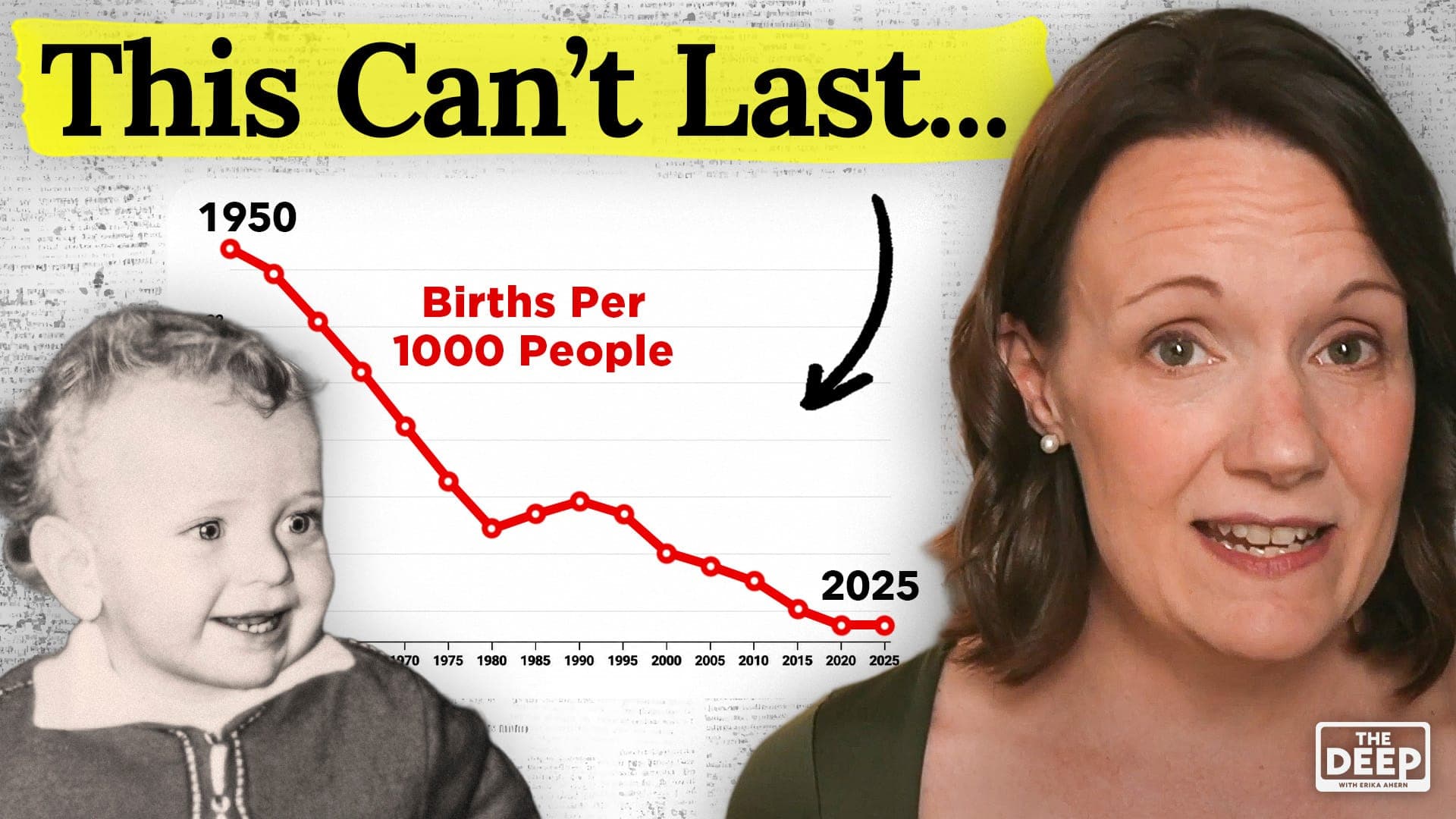
CNN recently published a truly provocative headline, The Most Feminist Thing You Can Do For Yourself Is Not Take Birth Control. The authors argued that questioning birth control has become a point of unity for women across political and religious spectrums, especially in online forums. Between 2022 and 2024, the percentage of women using hormonal contraception dropped by four points. The first measurable drop since the advent of the pill. In fact, multiple peer-reviewed studies from countries in Europe, Asia, and the Americas suggest that Gen Z women are walking away from hormonal birth control.
Why is this happening now? Doctors, influencers, and legacy outlets like the New York Times, Oprah, Cosmopolitan, and the BBC are sounding the alarm, and they blame social media. A 2023 study found that 74% of YouTube influencers who spoke about birth control were negative about the pill. The medical establishment is warning women of a return to the dark ages, seduced by back- Backward Catholic or Maha snake oil salesmen who hate the science and want women barefoot and pregnant in the kitchen. Ditching the pill, they say, spells backroom abortions, shattered dreams, and new glass ceilings.
The pill, you see, isn't just a medical tool. It's the foundation of modern womanhood. It was the hinge of a cultural revolution, one that promised freedom but came at the cost of something far deeper. It's It's given to teens for acne, prescribed for PMS, and keeps women hooked for decades. It's become invisible, ambient, just there. But here's the question Gen Z is finally asking. What else is it doing? Gen Z women are starting to suspect it's doing a whole lot more than anyone told them.
Are they right to question it? Well, it turns out we all should. Here's what we do know about the pill and the women who are rethinking everything. The pill and other hormonal contraceptives, with the exception of localized methods like IUDs, prevent pregnancy mostly by telling a woman's brain to stop sending signals to her ovaries to release an egg. This happens through something called the HPG axis, the system that helps control hormones for things like periods and ovulation. Once hormonal contraceptives, including the pill, have fooled the brain, The ovaries make less natural estrogen and progesterone.
The normal monthly changes in those hormones stop, so no egg is released. When the woman has sex, there's no egg. No egg, no meet-up with the sperm, no baby. But did you catch that? The brain, not the uterus, is the primary target in hormonal contraceptives. The pill changes levels of sex hormones in the brain.
And not just the pill, but all the long-acting reversible contraceptives, or LARCs for short, that many women have embraced in place of the pill. A 2024 neuroimaging analysis showed that the way hormonal contraceptives prevent pregnancy is by actually altering the shape of a woman's brain. Hormonal contraceptives cause macro-structural changes involving both increases and decreases in volume in various cases. So, then the question I, as a woman, would ask next is, what effects does changing the shape of my brain have on me?
I mean, besides preventing pregnancy? Bottom line? Neuroscientists say, we don't know. What? Yes. The authors of the 2024 Journal of Neuroscience survey, Beyond Birth Control, call it an emerging field of neuroscience of hormonal contraceptives. The emerging neuroscience of hormonal contraceptives highlights the profound influence these pharmaceuticals exert on the brain. While significant progress has been made, the current body of research indicates that we are only beginning to explore this area in depth. So, what happens next? Which seems crazy given the number of women using a drug to interrupt healthy physical processes like their menstrual cycles.
How is this field only emerging after more than 60 years of the pill? The fact that the scientific consensus is that we don't know what it's doing to you completely explains why it should come as no surprise that women are turning in droves to alternative sources like TikTok and YouTube for contraceptive counseling. Call me nuts, but my sympathies lie with the girls scrolling Instagram. So, do we know anything about what the pill does to our brains at this point? Well, there have been some studies, and the initial results, especially when it comes to teens, are chilling.
About 25% of American girls have gone on hormonal birth control by age 18. But most brain studies so far have only looked at adults, not teens. That should send up all the red flags, because the adolescent brain is still developing, especially in areas that control memory, emotions, and decision making. During these formative years, natural hormones help shape brain connections and wiring for adulthood. No surprise? Studies show that girls who start birth control as... have different brain activity and structure as adults than women who start later.
They also seem more likely to experience depression or need antidepressants and face a higher risk of suicidal thoughts. There are also verified studies of negative effects on adult women. You've probably heard that the claim, hormonal contraceptives are linked to higher rates of cancer, has been debunked or has no scientific basis. But a report from the Catholic Medical Association lists no fewer than 49 peer-reviewed studies and reviews confirming this connection. One study found that women ages 20 to 49 who had used hormonal contraceptives within the past year had a 50% higher risk of breast cancer compared to women who had not used them.
Another large study found that women under 40 who used hormonal contraceptives for a year or more were four times more likely to develop Triple negative breast cancer, an especially aggressive type, but not other types of breast cancer. A study from the National Institute of Health also found 43.6% of women reported experiencing mood changes as a side effect of hormonal contraceptives at some point in their lives. The high levels of progesterone, a natural sexual inhibitor, being pumped into our systems by the pill have also been linked to altered sexual preferences.
Blunted cortisol release in response to stress, a phenomenon typical among PTSD patients, problems with learning and memory, and delayed or no return of fertility after stopping the pill. We currently have scientists studying the effects of estrogen suppression on cognition with similar concerning initial results, and all the researchers say we need to know more. So why don't we? Well, most people point to chronic underfunding of research into female fertility issues, from endometriosis to cervical cancer, as a real problem. Is it any wonder more and more women are saying, you may not know, but I think I know enough to ditch the pill.
So, maybe you're not a woman. Maybe you've never been on birth control. It doesn't affect you, right? Wrong. We just saw what happens to an individual's brain on birth control. Here's what happened to society. On October 15, 1951, two chemists and a student assistant in a lab in Mexico City made a breakthrough. They synthesized a progestin, norethindrone, that became the key ingredient for the first combined oral contraceptive pill, commonly just called the pill. Not everyone was excited, the Catholic Church comes to mind, but it wasn't just Catholics.
In a 1968 Reader's Digest article, author Pearl Buck warned, Everyone knows what the pill is. It is a small object, yet its potential effect upon our society may be even more devastating than the nuclear bomb. Buck was right. It was a revolution in a bottle.
Women consumed the pill en masse and praised it for enabling them, like men, to separate sex from babies, subjugate their fertility, and enter the workforce in greater numbers than ever thought possible. By the 1980s, drug makers had responded and were off to the races, tweaking hormone levels, introducing new progestins, creating formulas that mimicked a woman's natural cycle. The result? A product that was both powerful and even more popular. But the story doesn't end with the pill. Hormonal contraception has exploded far beyond the pill into shots, rings, patches, and implants that are over 99% effective in preventing pregnancy.
Today, hormonal contraceptives are among the most prescribed drugs in the world. 82% of women have used them, whether for birth control or other issues like PMS, acne, endometriosis, or PCOS. Between 2000 and 2019, Hormonal contraception has exploded far beyond the pill into shots, rings, patches, and implants Teen use of hormonal contraceptives had tripled. Among women of reproductive age, about 1 in 3 rely on permanent sterilization, 1 in 4 use long-acting reversible methods like IUDs or implants, and 4 in 10 still turn to shorter-term hormonal prescriptions, mainly the pill.
But here's the thing. It was never meant to be long-term, and yet, generation after generation of women stay on it for years, sometimes decades. So, yes, it is still in widespread use, but the tide is starting to turn. Unquestioning acceptance of the pill is over, as that CNN headline suggests. The trend leans toward ditching short-term oral contraceptives. So, let's put some hard numbers to the anecdotal evidence. A 2025 study in the journal BMJ Sexual and Reproductive Health analyzed data from nearly 90,000 women seeking abortions in England and Wales between 2018 and 2023.
It found a sharp decline in hormonal contraceptive use, and a shift toward natural or no methods at all. Prescriptions fell from about 19% in 2018 to just over 11% in 2023, and long-acting implants dropped from 3% to just 0.6%. It's not just the UK. Western countries in general have witnessed a drop in the number of women taking oral hormonal contraception. And a surge in the use of permanent sterilization or non-hormonal contraception. Patrick T. Brown of the Ethics and Public Policy Center cautions against Catholic triumphalism here.
They're not all turning to natural, holistic, fertility-conscious maha lifestyles. The evidence just isn't there that this is happening in anything but a tiny minority, less than 3% of women. But while women using natural methods are still few, it's a group that's growing. In the last 10 years, fertility awareness methods rose from 0.4% to 2.5%, with an average age of users decreasing from 30 to 27.
So, why is this happening? 14% of Gen Z women have changed or considered changing their birth control after something they saw on social media. But this isn't just about online misinformation. The real question is, what's driving the other 86% of women who are questioning the pill? That's the question the troubling trend doctors don't want to ask. They need to confront the fact that That the loudest critics of hormonal contraceptives are not untrained Internet influencers, and they're not just Catholics. The sex realism movement is led by a number of agnostic or Christian-curious thought leaders like Mary Harrington or Louise Perry.
A growing chorus of professional women, scientists, scholars, and journalists are also sounding the alarm. Different fields, same message. The wonder drug that changed everything is also quietly changing us. So, why haven't most doctors caught on? Why do 83% of women report that their providers never mentioned the possibility of, for example, psychological effects of the pill? I'm going to hazard that for a lot of doctors, like other professionals in industrial complexes, it's a matter of strategic ignorance. The medical industry favors efficacy above just about everything else.
And look, in life-or-death scenarios, you can understand why. You want the thing that will save the patient on the table. But when it comes to long-term dependence on pharmaceuticals to achieve a certain effect, remember 78% of women stay on the pill for over two years, is getting the job done enough? Not every doctor, but enough doctors, have turned a blind eye to the cries of women who were experiencing negative effects. The psychological flip we are watching in Gen Z is not a blip.
It's a generational rebellion. The younger generations are looking for truth, for real life, for something uncorrupted by boomer-era institutions, Cronkite, Clinton, Big Food, and Big Pharma. Gen Z women are searching, ditching the pill, but in its place, they are embracing equally damaging, long-acting hormonal contraceptives and permanent sterilization. But the fact that they're searching and questioning is an opening.
And it is incumbent on us as Catholics to give them a way out of the confusion. If women are more open to making that psychological flip, it's time to get out there and offer them something different. It's still a tiny fraction of us who get to live life free from hormonal contraceptives. The revolution isn't here yet. But there's a new openness in the younger generations to something other than mindless acceptance of the pill. And it's vital that we spread the word, because deep down, we all want something more than management.
We want to be healed. We want meaning. And that, I think, is the revolution worth starting. If you liked this episode, be sure to subscribe to the LOOPcast. We bring you a new episode of The Deep every Thursday at 4 p.m. Eastern.
.jpg&w=3840&q=75)