Why Gen Z Wants To Return To A World They Never Knew | The Deep
Millennial nostalgia isn't just for Millennials anymore. As Americans flock to vintage fashion, hackey-sacks, Gameboys, and pre-digital lifestyles, a deeper question has emerged: are we escaping the present… or rediscovering something we lost that’s worth saving?
Transcript
Read the full transcriptAuto-generated · 1,905 words
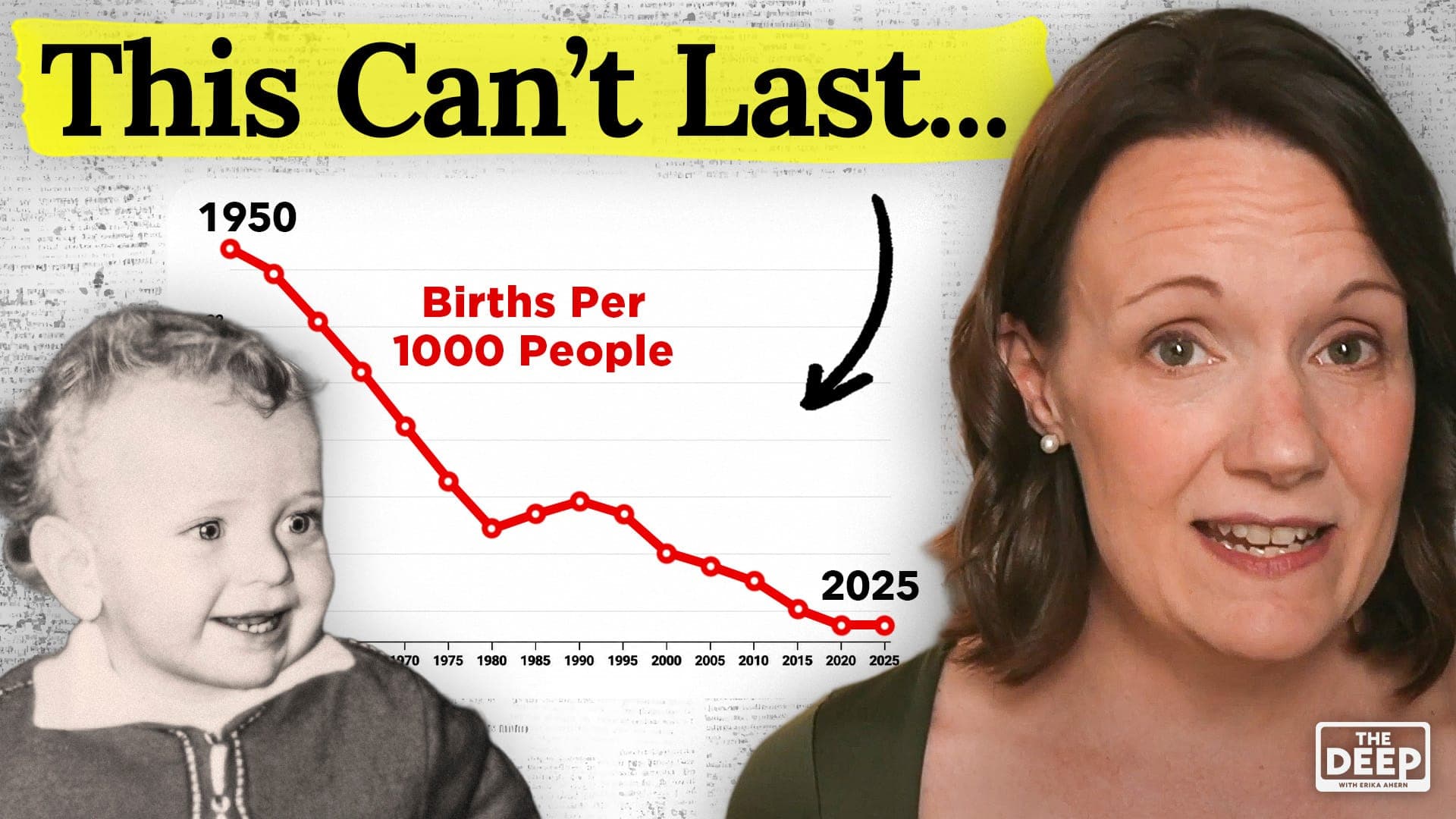
I'm a millennial, and the 90s were my decade. Mixtapes, Hacky Sacks, Blink-182, Celine Dion. Millennial nostalgia is real, but it's not just millennials. Gen Z is low-key emo for the days of grunge, punk, mall culture. They're nostalgic for a decade they never lived through. According to recent survey data, 68% of Gen Z adults report feeling nostalgic for eras before their lifetime. 73% say they're drawn to 90s media, styles, hobbies, or traditions. They're driving a niche analog economy, buying up vinyl, physical books, and board games.
Matt Walsh recently warned that the return of 90s culture is a sign of something deeply wrong. Gen Z resurrects toys and games from the past because they didn't have any of their own. And in a way, he's right. Instead of creating its own distinct aesthetic and culture, Gen Z seems stuck with longing for other generations' childhoods. But I'm not convinced that it's all bad news. If the 1990s was the last decade of distinct American culture, is millennial nostalgia the final gasp of a decadent society?
Or could Gen Z's longing for a past they never knew end up saving us all? Longing for a better past is one of our most powerful, most distinctly human desires. The word nostalgia comes from two Greek roots, nostos meaning return home, and algos meaning pain. Nostalgia is the pain of wanting to go home. Studies on historical nostalgia show that Gen X, Millennials, and Gen Z all report substantially stronger nostalgia than boomers and the silent generation.
Millennials report the highest rates, but Gen Z isn't far behind. Two-thirds of respondents said that exploring eras before their own lifetime helped them cope with stress about modern life or anxiety about the future. People aren't merely remembering the past, the sights, the smells, and toys of their lost youth. Many of them are longing for a past they never experienced. That's a strange thing if you think nostalgia is merely memory. You can't miss something you never had, and yet, people do it all the time.
It's called Animoia. College kids binge watch The Office. A teenager bricks her phone to experience life unplugged for a few hours. A young mom spends hours looking at photographs of children from the 1950s and feels genuine grief. Nostalgia isn't ultimately about remembering. It's also about desiring. It's about trying to re-present a place where life felt more human and more meaningful. Whether that place actually existed is another question. For people raising their kids in the 80s or the 90s, things weren't tidy or clear at all.
They didn't know that they were in the last analog era. They didn't know what would come next or how their day-to-day decisions would lead them right into the digital revolution. For Gen Z, they look back at that past, but they're only ever tourists there. And what do tourists do? We go shopping. American nostalgia has fed an insatiable market for the endless fresh looks at childhood stories, heroes, and villains. Gen Z shops vintage, retro, heritage brands. Marketing plans tell Coca-Cola and Levi's to highlight founding dates and original logos.
To signal authenticity and the good old days. Pizza Hut just renovated hundreds of locations as 90s throwbacks. Big red cups, stained glass lamps, and Pac-Man game units. And my favorite, in 2003, SNL made fun of mom jeans. Today, they are so back. Millennials and Gen Z gamers increasingly gravitate toward older games that can be played offline. On their own terms, without constant updates, server checks, downloadable content packs, subscriptions, microtransactions, or online accounts, they want physical cartridges and Super Mario on a Game Boy.
And that trend gets us closer to what's really happening beneath the surface. Because nostalgia is not fundamentally about Nintendo or Pizza Hut. Superficial stuff triggers nostalgia. But it's ultimately about something much deeper. Nostalgia is about a growing desire for a world where not every aspect of life is mediated by a screen, a world where people could live offline. We can't reduce Gen Z nostalgia to perpetual adolescence. It's not just people refusing to grow up. The desire for a past they never knew is primarily a reaction to what the digital age took from them.
For many, it's also a desire to create a safe space where their future children can enjoy a phone-free childhood. Think about the difference between childhood in 1995 and childhood in 2015. Millennials rode bikes until dark. We called our friends on a landline. We got bored. We waited for buses and wandered around malls. We were mostly unreachable. The 90s weren't paradise. High school was still brutal. Teenagers still felt awkward. There was plenty of vice going around. Helicopter parenting was already taking off, and everybody started getting trophies.
But we weren't constantly online. Within 30 years, our world largely disappeared. Gen Z childhood unfolded amid constant tracking, texting, photographing, posting, sharing, documenting, monitoring, and recording. Their childhood memories aren't just in their minds or physical photo albums. They live forever in databases owned by Meta or Google.
Their identities developed in public. Every awkward stage, every mistake, every bad haircut. And every embarrassing opinion. The pressure that once came from a handful of classmates now comes from hundreds or thousands of people. Gen Z grew up being watched. As long as you have a smartphone and an internet connection, your behavior is being tracked, analyzed, personalized, and monetized. Gen Z became the first true generation of digital natives. They don't remember a world before the internet, and the more reflective of them find that deeply unsettling.
A recent Harris poll found that 80% of Gen Z adults believe their generation is too dependent on technology. 75% worry about social media's effect on young people's mental health. A majority believes new technologies are more likely to drive people apart than bring them together. No wonder so many young adults are reaching for something tangible. Film cameras, handwritten journals, live concerts. That's why the 90s occupies such prime nostalgia real estate. The decade was a unique historical moment, old enough to be pre-smartphone, and yet modern enough to feel familiar, like it could have been their own childhood.
The internet existed, but Wi-Fi was still in its infancy. We still lived primarily in the physical world. Gen Z doesn't romanticize that decade because the pizza buffet was bigger. They romanticize it because people were not digitally colonized. So, is 90s nostalgia just romantic escapism? It's true that our brains naturally soften certain memories over time. People reconnect with a high school sweetheart decades later, and they remember the first kiss while forgetting the painful breakup. A mother remembers some of the pain of childbirth, but mostly just that first glimpse of her baby's sweet face.
Human memory has the capacity to preserve meaning while dulling some of the sharpest edges, and that can distort reality, but it's also a powerful tool for human survival and flourishing. Nostalgia reminds us who we are and where we came from. The longing for home strengthens identity and community. Think of Odysseus crossing the wine-dark sea. What keeps him going? The memory of home and the desire to return. Human beings need that orientation toward the permanent things, which are always worth returning to.
One of the great crises of the modern West is precisely the loss of connection to tradition. Nostalgia helps us persevere after the trauma of revolution, a digital revolution, a barbarian invasion, a brutal exile from home. Long before smartphones, a Jewish songwriter composed Psalm 137. Which describes the Jewish people in exile after the destruction of the first temple and Jerusalem itself. By the rivers of Babylon, there we sat down and wept when we remembered Zion.
If I forget you, O Jerusalem, let my right hand wither. The pain of longing for home preserved their identity as a people with a shared past, a shared place, and a shared faith. We don't know the exact year he wrote that song. But the Jews remained in Babylon for three generations. Their children's children were taught to long for a home they had never personally known. They had to dig deep into the past in order to get home for the first time.
There's nothing strange about being nostalgic for a time you never knew. After all, we are all longing for our final home in heaven which no eye has ever seen. C.S. Lewis often described this experience as senshukt. A longing awakened by beauty, memory, music, landscape, stories, and moments that seem to point beyond themselves. But nostalgia certainly has a dark side, because the longing for home can become an escape from reality. Never was this clearer than in 2020. Nostalgic media consumption surged during the pandemic.
When we are feeling isolated and adrift, Disconnected and anxious, we tend to ask, where did it all go wrong? During the lockdowns, Americans rewatched old shows and revisited childhood movies. We played old games and listened to old music. Nostalgia brought comfort in a cold world, but for millions, it became a trap. Misplaced nostalgia can stunt creativity so that, instead of applying lessons from the past to solve today's problems, we retreat into fantasy. An alternate reality. The truth is that the 90s weren't heaven, but they got some things right that we have lost.
The 1950s certainly weren't great, they produced the 60s after all, but we have also lost something real and good from that time. Every decade contains its own peculiar beauty, its special suffering, and its collective sins. Human history cannot bear the weight of our deepest longings. The present moment might really be worse than others. Sure, Americans are safer and wealthier than at any point in history, and our life expectancy is the highest ever. The United States produces more energy than ever, and the stock market is miles high.
None of it matters. We are also more pessimistic about the future than ever. Everyone feels like things are only getting worse. Like... We took a wrong turn somewhere and ended up in the Emerald City, but we're still living in exile, and all we really want is to go home. Millennials long for the pre-digital world that we knew, but Gen Z never had it at all. If a more human way of living is behind us, then looking back may be the best way forward.
Lewis wrote in Mere Christianity, If you are on the wrong road, progress means doing an about turn. And walking back to the right road. And in that case, the man who turns back soonest is the most progressive man. There is nothing progressive about being pig-headed and refusing to admit a mistake. Going back is the quickest way on. Gen Z and millennial nostalgia for a pre-digital age is actually necessary at this moment in history. We recognize the mistakes of recent years, and we desire a better future.
We are remembering that we were made for the permanent things. When an entire generation starts longing for a world they never knew, maybe what they're really longing for isn't another decade. Maybe they're longing for the homeland they were made for.
If you liked this episode, be sure to subscribe to The LOOPcast. We bring you a new episode of The Deep every Thursday at 4 p.m. Eastern.
.jpg&w=3840&q=75)