Lucca: A Journey Through Time
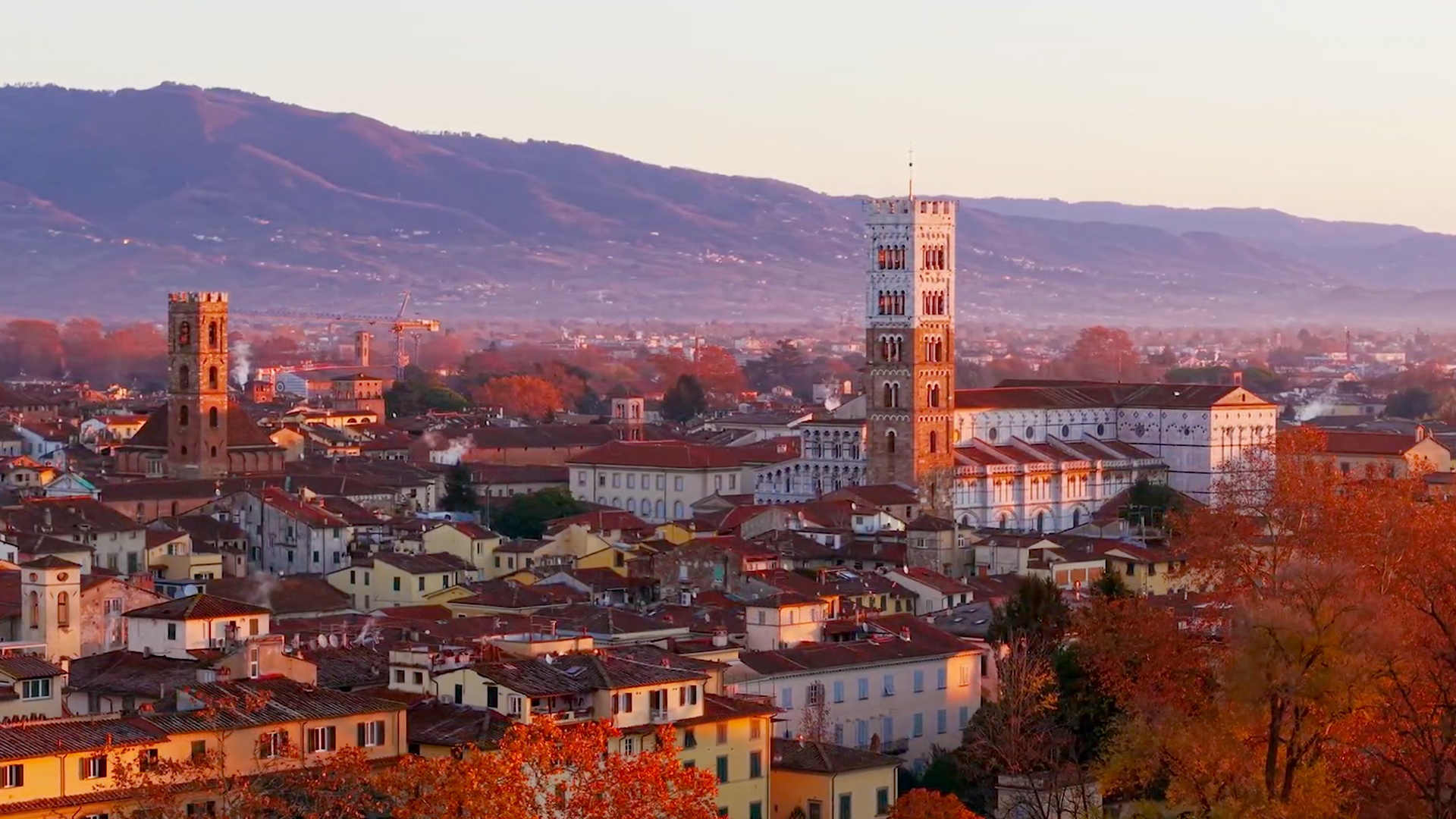
From its fully-intact Renaissance city walls, to its numerous church towers, to its unique piazzas and treasured religious traditions, Lucca is an enthralling city of discoveries that is also home to one of antiquities most unique crucifixes.
Transcript
Read the full transcriptAuto-generated · 950 words
Imagine a place where time has stood still. Not by accident, but by choice. A city where stories are told in hushed tones, where you can walk along a path suspended 40 feet in the air. This is Lucca, an elegant and understated city with the past of a true main character.
It's the only Italian city to have kept its Renaissance walls completely intact, a four-kilometre hug of ancient bricks that never fired a single shot, but has protected the city from centuries of battles and floods. Today, the walls have become a park and an open-air stage where life moves at a slow and harmonious pace, a rhythm that culminates every year in September with the Luminara di Santa Croce, a solemn procession in honor of the Volto Santo, the ancient crucifix venerated by the people of Lucca.
Lucca is a history book that reveals itself page by page. It all begins right here, with these Renaissance walls, a true marvel of engineering. Legend has it, they were designed not just for defense, but also to divert the course of the Serchio River, saving the city from disaster.
But the true soul of Lucca is found inside. It's the city of a hundred churches, each with its own bell tower and its own treasures. It's the city of towers, like the Guinigi Tower, the only one in the world with trees growing on its roof. And then there are the unique piazzas. The most famous is undoubtedly Piazza dell'Anfiteatro. Built on the ruins of an ancient Roman amphitheatre, today it's the beating heart of Lucca, an open-air living room.
Lucca isn't just about beauty. It's also about mystery, faith, and legend. At the heart of it all is the Holy Face, an ancient wooden crucifix housed inside the Cathedral of San Martino. This year, a meticulous restoration has brought back the original colours and expression of a work that seemed lost forever.
This restoration obviously has a cultural and scientific meaning, because it is the oldest crucifix in Europe. For us, the Church of Luke is also a spiritual moment, because the original colours reveal the author's thought, which is to show a look of faith on the crucifixion. It is the paschal gaze that says, in reality, the suffering Christ is the victor, and from the cross Jesus reigned, so the royal image of Christ on the cross translates this faith of the Church.
The technical difficulties are enormous, because it is a three-dimensional work, with the cross, it is 4.40 meters, almost 4.5 meters, a very ancient work, and above all, we did not know it. Under the black state, we didn't know what was there, not even what kind of wood it was, the construction techniques. So, the first part of the restoration was a long diagnostic campaign.
But perhaps the most extraordinary thing about this crucifix, and this has also amazed the workers, which is a work from the ninth century, very ancient, the only one with the cross still intact, is that under the dark patina, the colors, better preserved, the most intact colors are the oldest, most precious ones. And fortunately, the intervention, even after integration, has been really minimal.
After this restoration, we have really rediscovered the Holy Face, a crucifix that has rediscovered its colors, which is important because these colors are not random. The King's gold, which triumphs over death, and the cross. It is no longer black, it is red, it is purple, it is colored, because with the resurrection, that cross, as a tool of death, becomes the throne of grace.
But that's not the only tradition Lucca has preserved. There's an ancient custom tied to the coronations of emperors and popes that survives only here in the cathedral. The Stope tradition is an ancient tradition that was linked to the coronation of the emperor and the pope, which disappeared all over the world, but survived here in Lucca. During the singing of the Gloria, the Stope is set on fire, which burns immediately, and the deacon whispered to the bishop's ear, sic tracit gloria mundi, that is, how quickly this fire is consumed, so quickly your glory will be consumed, do not attack us.
Not considering it an important thing. The important things are other things, so I call for humility and a sense of service connected with authority, once by the Emperor and the Pope, and today by the Bishop of Lucca. On September the 13th, the city prepares to celebrate the Luminara of the Holy Cross, one of Italy's most enchanting nocturnal processions. Thousands of people, from young to old, pour into the streets for this ancient ritual. Not even the rain can stop this flood of light.
It's a river of light that illuminates the buildings and churches, an experience that unites faith, tradition, and a sense of community. This year, the ceremony takes on an even deeper meaning thanks to the restoration of the Holy Face.
It is a message of hope, of faith, which in this jubilee is particularly, I would say, also connected with the theme of pilgrims of hope that Pope Francis wanted to give this jubilee year. The Holy Face is not a work of art. For the Luccan people, it is a symbol of identity, and for the Church of Lucca, it is the most venerated crucifix. It is a truly eloquent look for today, because, obviously, we too, in the face of the contradictions of the present, must choose whether to look at them with the look of the world or with the look of faith. The Holy Face encourages us to do the second thing.