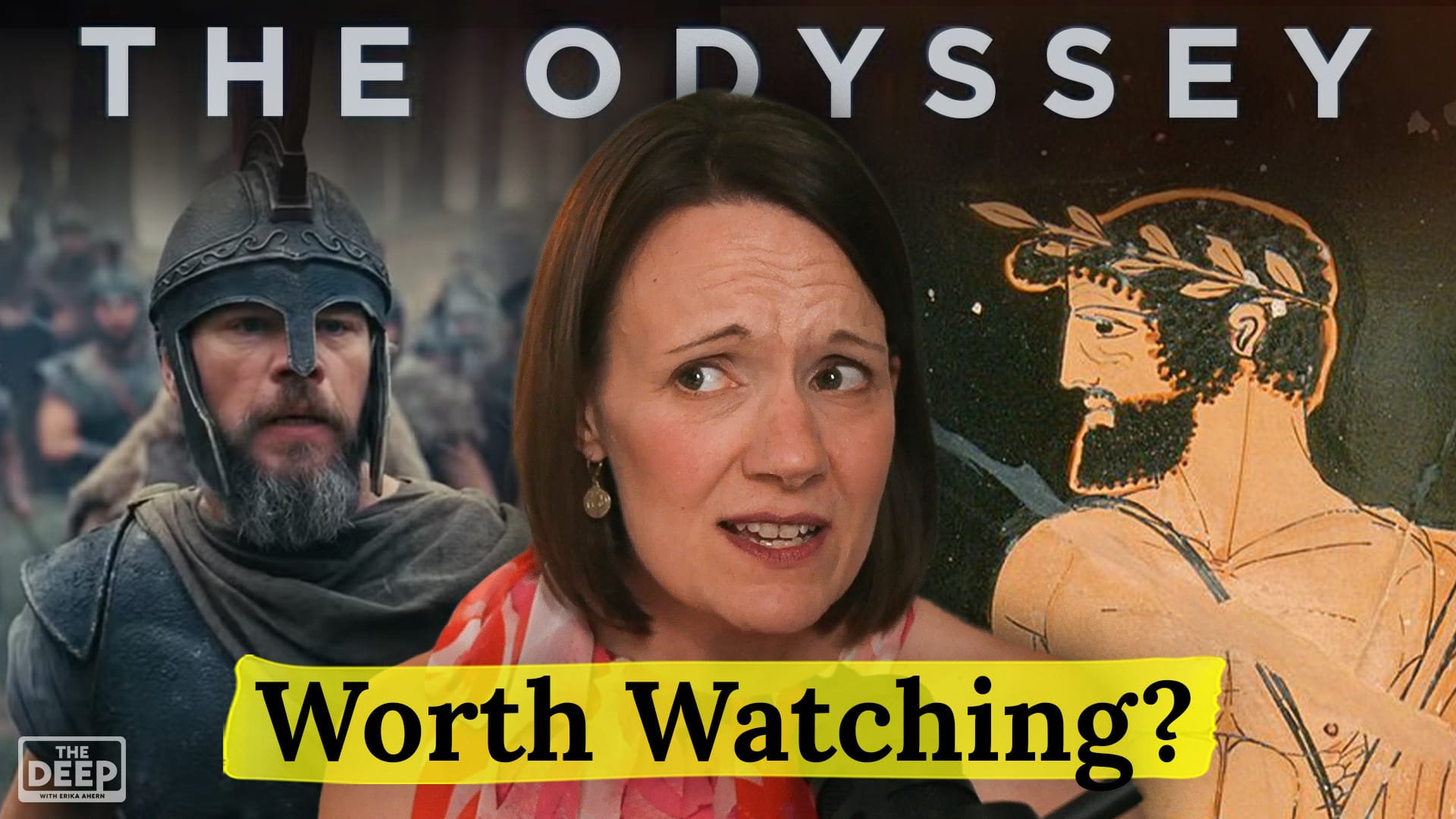
Nolan's Odyssey Looks Like Homer. It Isn't. | The Deep
This is the Odyssey review you didn’t expect. Erika breaks down the good, the bad, and the (confirmed) ugly in Nolan’s adaptation of the founding myth of the West.
Transcript
Read the full transcriptAuto-generated · 3,017 words
No movie since live-action Snow White has received as much hate before it came out as Christopher Nolan's Odyssey. The teaser trailer got 769,000 dislikes on YouTube in a matter of days. As the kids say, the trailer was ratioed. 90% of viewers hated it. Nolan shrugged off the backlash, comes with the territory, and remember, you all hated Batman, and you haven't even seen it yet. Which is a fair point. So, I went to see it. I sat through three hours of Nolan's never-ending Odyssey.
Spoiler alert, he changes everything in the end to imply that, in fact, the Odyssey never ends. And as Matt Damon's very cool Viking longboat came upon a, spoiler alert, dolphin pod, I thought, wow, this is really cool. I loved the visuals. I loved the cyclops, the sea, Penelope's screen, Cersei's pigs. And to my surprise, With one or two obvious exceptions, which I will get into, it's not woke on the surface. So, if it's that great, and critics love it, and audiences have repented of their initial dislikes and are now rating it 98% on Rotten Tomatoes, why did I leave the theater feeling like we still have to save Western civilization, and I'm too tired to do it?
What if the Odyssey Derangement Syndrome wasn't overblown. It was just misdirected. What if the casting controversies and random cursing and daddy lingo backlash were all just masking a much deeper travesty, a tragedy more Homeric than Tom Holland's Joggers?
Leading up to its release, as you probably know, the Odyssey's marketing team gave us a masterclass in outrage promotion. Social media lit up over so-called colorblind casting and possible genderblind casting, Instagram moms were mocking Anne Hathaway's Botox, and the firestorm all pointed to what we know, the public's growing resentment against a Hollywood that just can't help making political commentary on what it sees as problematic source material for everything we love. So, When we got celebrity interviews like this… When you read The Iliad and The Odyssey, very little time is spent in the perspective of the women.
Right. Right? It's told from a very masculine side of things, but this film takes a lot of… It takes time to really consider things from the female perspective. You might forgive the allergic reaction. For the last 40 years, we've been conditioned by Hollywood's woke adaptations… of everything. Snow White. Feminist Jane Austen. The Rings of Power. Maybe the outrage is understandable, but was it justified? Was the film really just a bunch of actors dressed up as Greeks, or maybe it was Robin Hood?
Some of them looked like Batman. Was it serving up another dose of superficially woke propaganda? And I am happy to recommend, do not allow the hyperventilating harpies of Twitter. To deprive you of seeing this film. Yes, I have my criticisms. More on that in just a minute. But it wasn't Feminist Ghostbusters, or The Last Jedi, or Supergirl. The Cyclops is awesome. And the whole scene where Odysseus restrings his bow and shoots the arrow and slaughters the suitors, that's worth the price of admissions.
The 100% shot in IMAX cinematography, also worth the price of IMAX. But it's not. Homer. As the opening credits remind you, it's based on Homer. As many have already pointed out, it is Nolan's Odyssey, and here's why. Every culture tells and retells its foundational stories. That is not the issue. Homer has been interpreted and retold endlessly. James Joyce interpreted Homer in Ulysses. Derek Walcott interpreted Homer in Omeris. It's been adapted for film many times with casts of varying racial persuasions. My personal favorite, the Coen brothers, interpreted the Odyssey here.
You don't say much, friend, but when you do, it's to the point, and I salute you for it. But that's not what Nolan claims he was doing. Instead, he and the entire marketing team for the Odyssey perpetuated the myth that the audience would see Homer's Odyssey, authentic, an interpretation for our time. He told the New York Times, for example, he was being true to the Odyssey and honoring the text. Quote, you try to be true to the spirit of it, and you're trying to add something to it as well.
You're trying to add a little something to the conversation about what the. represents. That cultural conversation has been going on for 3,000 years. He's right. We need these stories, not only for a great summer blockbuster that makes millions on its first weekend. We need to remember the Odyssey, because it is a roadmap home, a tether in the storms of human life and amid the rise and fall of civilizations. It's precisely for that reason that not all interpretations are equal, and not every adaptation is worthy of its source material.
Nolan himself believes that. In fact, in the same interviews, he is pretty judgmental of certain interpretations of Homer. We look at the ancient world. People tend to view it in weird ways. There's a lot of cultural prejudice. There's a lot of, yeah, they're sort of elevating it because it's old, you know, whatever it is. But is it really just weird bigotry to elevate an epic poem that's been around for 3,000 years? I want to center it on that and make it feel very fresh.
For modern audiences. And do away with some of those assumptions that aren't based on anything logical. They're just, as I say, cultural prejudices or things over time. Nolan said repeatedly that to honor the text, they went back to what's in the archaeology. And what does that tell us? What do we know about Homer's time? How were things portrayed in the earliest possible portrayals of that? So, he's claiming some kind of original purity.
But he can't have it both ways. You can't be sincerely trying to undo cultural prejudices only to replace them with your own cultural prejudices, and then claim to have some purest original insight into Homer. That's when the film starts to fall apart. You're asking your audience to immerse themselves in a foreign, ancient world with its own rules and its own particular setting, but at the same time, Nolan makes specific choices that are so jarring, it's distracting and pulls you out of that world.
And this is the perfect place to add a side note that, yes, the casting of Elliot Page, a woman who thinks she's a man and has had surgeries to perpetuate that dysphoria, was really distracting. Pulling Sinon out of the Aeneid to replace Achilles in the Odyssey could have made sense, but Elliot Page carries too much baggage as a personality and an activist to convince... Anyone that she's the greatest worrier among the Greeks. But that's really all I want to say about that, because I think the transing of Sinon is actually a distraction from the bigger tragedy here.
Going into the theater, everyone knew from trailers and interviews that Nolan had rejected elevated language for his script in favor of more everyday speech, like having Telemachus say daddy instead of father. The language, as well, is very modern. It's very contemporary, easy to access. I mean, you say dad rather than father. Sure. I mean, what's the thinking behind that? Because I wouldn't have even said father back in the day, would I? I wouldn't be in Greek, so it's no less correct.
Right, Tom. No one, literally no one I have seen criticising this film is saying that Nolan should have pulled a Mel Gibson and made all the actors speak in ancient Homeric Greek with helpful subtitles. The issue is that using language like Daddy, and let's go, and dropping F-bombs is dissonant. It feels out of place in the context of an epic, and clashes jarringly with other lines Nolan preserves, such as, to burn Troy is to burn the world entire. Nolan's choice to use that language was inspired by a very specific muse, Emily Wilson.
She dropped her translation of the Odyssey in 2017, and like this summer's film, It sparked a firestorm of criticism. Nolan told Empire Magazine, I think it's the Emily Wilson translation that begins, tell me about a complicated man, the genius of the character, the cleverness, the inventiveness of him. That was a huge part of what interested Nolan. He's referring to the very first line of the epic poem. Since Tom Holland brought up the Greek, I will start there. In Greek, Homer's opening line reads, Andromoe, enepe, musa, polytropon.
Word for word, it means, the man, to me, speak, O muse, of many twists or turns, ways, turnings. That's Odysseus. Other translations give us different ways of interpreting this. Fagles tells us, sing to me of the man, muse, the man of twists and turns. Butler is a little more concise. He says, tell me, O muse, of that many-sided hero. Lattimore's translation, tell me, muse, of the man of many ways. Wilson? She chose to leave out the muse and the twists. Her rendition, Tell Me About a Complicated Man.
It's a modern colloquialism that places Odysseus squarely in a modern idiom, which is also where Nolan placed Matt Damon. Wilson says she chose complicated and other modern phrases like delusional behavior, egotistical, destructive impulses, and handbag. To, quote, make visible the cracks in the patriarchal fantasy. In Wilson's introduction, she makes it pretty clear that by complicated, she means deeply flawed, as in pretty much just flawed. Or as one commentator said, Wilson places Odysseus in the company of modern white antiheroes like Michael Corleone, Tony Soprano, or Walter White.
Homer's Odysseus is a cunning, brave, willful hero. A man of twists and turns who defies the gods and lives to fight another day. Nolan's Odysseus is a bruised and sensitive ponderer who ends the film with a soliloquy that all but undermines anything and everything that would have passed for his culture. Most translations deliver Odysseus' stock epithet as resourceful, wily, or Odysseus of many councils. That's probably the cultural prejudice Nolan was referring to in his interviews. Wilson just says, lying Odysseus, or wily Odysseus, the lord of lies.
For all the complicated man talk in her translation, Greek warriors are, for Wilson, pretty simple. They're the bad guys, who destroy their own civilization through cunning, deceit, and smashing Zeus's order. Like Nolan, Wilson talks a lot about honoring the text and making it fresh. But to understand Nolan's interpretation, it's important to recognize what both of them mean by Honoring. The project is basically a progressive one, to scrape away all the centuries of verbal and ideological buildup, the Christianizing, the nostalgia, what Wilson perceives as sexism, and elevated language to reveal what?
A Helen who's more palatable to a feminist? Sirens who don't seduce but psychoanalyze? But that's the translation Nolan was working with. And while he rejected some of Wilson's tropes, The underlying assumptions about both Homer and the way the moral universe actually works today showed. The most impressive part of Nolan's film was the sheer gutsiness in taking on a massive epic in only three hours of storytelling. To weave a story that hung together, any filmmaker would be forced to merge portions of the Odyssey, remove some, and add in others.
And honestly, I think he would have done better to pull a Batman and tell the Odyssey over three films. Because the choices he made didn't honor Homer. It fundamentally remade the Odyssey so that it's even less Homeric than 10 Things I Hate About You is Shakespearean. Nolan's Odyssey is fundamentally a post-Christian therapeutic fantasy. The Greek gods, though mentioned, never appear as real characters, and those that do are females who act as post-trauma fever dreams. Feminist correctives for toxic male aggression and psychotherapists for a broken man.
Casting Zendaya as Athena doesn't bother me, but reducing Athena, the goddess of wisdom, to what seems to be a figment of Odysseus's PTSD does. The goddess in the film is seen only by him and always takes the form of a beheaded Trojan girl. Samantha Morton Searcy turns his men into Pigs, which is one of the best scenes in the movie. It is so horrifying. But she's really just showing Odysseus who they really are. Nolan lets her off the moral hook by implying that she turns men into beasts and feeds them to each other because of some dark abuse in her past.
She's a lesson to us all of what becomes of men when they are unchecked by women. They turn into pigs. Homer's goddess, Calypso. Seduces a willing Odysseus with sex, food, and the promise of immortality. She is replaced by Nolan with Charlize Theron wearing a beach cover from TJ Maxx. She acts as a sort of therapist for the broken Odysseus, feeding him the lotus to erase his traumatic memories of his role in the fall of Troy and the deaths of his men.
When Odysseus finally, on her urging, surrenders to Zeus, he floats home on the sea. But surrender to Zeus is not a good idea. It is not a good idea. Isn't a personal act of submission to a particular personal being. It's an act of acceptance that I'm what's wrong with the world. The founding myth of Nolan's Odyssey is that the stability of Zeus's law, a sort of post-Christ do unto others, is under threat from some unnamed sea people. The entire point of Odysseus's journey isn't to arrive home in the end.
It's a self-realization that he is the threat. He is the sea people. He's not a hero. He's not noble. And his so-called cleverness is, just as Wilson said in her translation, lying. The Trojan horse, which was his idea and is another amazing scene in this movie, love it, is not a clever trick that wins a war fought for a beautiful woman or to defend the virtues of Greek civilization. The horse, a fake gift presented, ironically, to the Trojans by a fake man, Elliot Page, is the beginning of the fall of Odysseus's entire world, brought on by his own deceitful nature.
As he is weaned off the lotus and surrenders to Zeus, he still only wants to get home. But when he gets there, he finds he can only reclaim his queen and kingdom through still more treachery, more deceit. And slaughter. Even if the audience cheers when he strikes the first suitor, in the back of our minds is a nagging memory that in the previous scene, he's told Penelope, through a confessional like screen, that similar violence in the sack of Troy was the beginning of the end of their entire kingdom.
Only by exposing the oppression, the violence, and his own will to dominate in himself can Odysseus restore the egalitarian peace. And that's why Nolan had to change the ending in a radical way. Spoiler alert, Odysseus must never enjoy power again. He and Penelope embark on a journey west, leaving Telemachus, who barely participates in the slaughter of the suitors, to rule. And I can't say it better than Leo Leibovitz. Nolan's Odysseus, in other words, is the perfect tragic hero for our time.
Beautiful, rueful, remorseful, and all too ready to accept the fact that his civilization is at an end, and that there's nothing he can do about it. A great hero, maybe, but absolutely not the one we need right now. As my esteemed cultural commentator colleague Tom Pagasic asked me, why the heck should we care? Because as a people, we are losing our stories, our memories, and our roots. The Odyssey is not just a film. fantasy, as the cast insists on calling it in every single interview.
It's a civilizational myth, a story that tells us who we are and where we came from. When we change those myths, we change ourselves. As my friends at the Ascend podcast put it, the cult of Christopher Nolan seems stronger than the cult of Homer in the public square, and we should consider what that means for the West. We don't all set out to read classics through the lens of social justice and religion. We don't all set out to read classics through the lens of social justice and religion.
progressive politics, and Nolan largely avoided that. But we also don't set out to read them through our own lens of therapeutic religion. We don't want every ancient hero to undergo a struggle session with the sirens. We just want him to bravely and nobly reject their empty promises. We want to actually encounter how other people thought and ask them why they acted the way that they did. William Hazlitt once wrote that by conversing with the mighty dead. We imbibe sentiment with knowledge.
We feel the presence of that power which gives immortality to human thoughts and actions, and catch the flame of enthusiasm from all nations and ages. And I think Christopher Nolan, the great risk taker, wanted that, but he tried to have his cake and eat it too. He was trying to do too many things at once, impress the experts by casting himself as a sincere critic, make Odysseus into a 21st century anti-hero, be brave and stunning, And produce a summer blockbuster. In the final line of Nolan's film, Odysseus bids us farewell as he sails west.
He says, It's a fitting end to Nolan's myth-making. We can overlook his mistakes and enjoy our popcorn, but we must not forget where Nolan went wrong. He thought he had to defy the gods and Homer to become a bard for our time. To create a new odyssey for an age of weak men, when in fact, perhaps what the world needs most now is a return to the telling of true hero tales.
If you liked this episode, be sure to subscribe to The LOOPcast. We bring you a new episode of The Deep every Thursday at 4 p.m. Eastern.