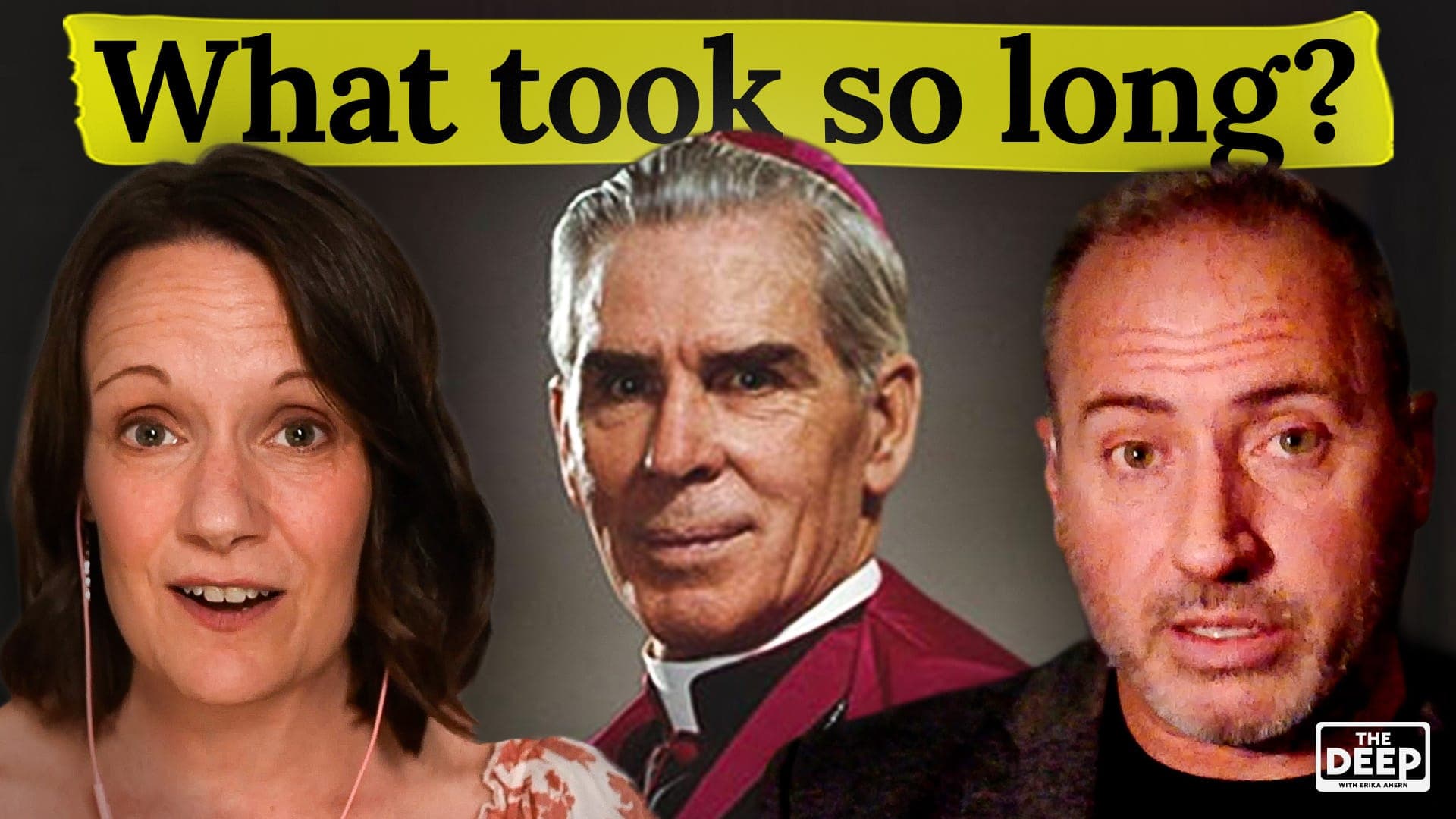
Nuns Helped Build America, Then They Vanished. Why? | The Deep
179,000 nuns… down to 33,000. What happened? In this episode of The Deep, Erika uncovers the shocking collapse of America’s Catholic sisters – an 82% decline – and the hidden forces behind it. Was it Vatican II, feminism, or something deeper? And why are a few communities quietly rising from the ashes?
0:00 Intro: Why did America’s nuns disappear? 3:42 History of religious sisters in America 5:50 What lead to the decline? 8:50 The destruction of the family 11:18 The sexual revolution and feminism 12:16 The media and cultural narratives 13:04 Debt and careerism 14:02 The fallout 16:52 Who survived? 19:04 Thriving communities today 20:32 Conclusion: Why we need religious sisters!
Watch The Deep on Zeale: https://zeale.co/podcasts/the-deep
Transcript
Read the full transcriptAuto-generated · 2,890 words
In 1965, there were 179,000 Catholic sisters in the United States. They ran schools, hospitals, shelters. Their habits were synonymous with Catholicism. Within a generation, they all but disappeared. Today, only 33,000 sisters remain, an 82% decline in 60 years. We used to have three sisters. For every one Catholic priest, today, it's just one-to-one. Less than 1% of sisters are under 30, and the average age is 80. The sisters left a gaping hole in the fabric of American Catholic life. In 1920, sisters accounted for 92% of Catholic school teachers.
In 1970, they made up just below half, and today, they make up only 1.5% of Catholic school teachers. of faculty. In 1968, 770 of America's 796 Catholic hospitals were led by nuns or priests. By 2011, that number had shrunk to just 8 out of 636. Somewhere in the 20th century, Catholic nuns experienced an extinction-level event. They left a vivid impression on the American imagination. Older Catholics Still tell stories of the nuns who taught me. Secular movies and books still capitalize on the juxtaposition of the habit and traditional churches with the drama of mass murder, sexual perversion, or plain old-fashioned doubt.
Films from kinder times, like The Song of Bernadette and The Sound of Music, feel like glimpses into a lost and beautiful world, because in fact, that world disappeared, and it makes us sad. Today, very few Americans have ever met a nun in real life. We get our nun fix from Hollywood, which is anything but flattering. It's hard to comprehend just what that loss meant for our parishes, our country, and our own faith lives. So, whatever happened to America's nuns, and are they ever coming back?
Catholic institutions have seen massive transformation and, yes, decline since the Second Vatican Council. In 1965, 1,575 new priests were ordained, joining the 58,000 already in active service in the United States. By 2020, there were just 25,000 diocesan Catholic priests left, with more than a third of them retired. That was a shocking decline of about 40%. Thank you for watching. But that decline was nothing compared to the sisters who left the convents in droves. A 1984 study indicated that between 32,000 and 39,000 nuns quit their vows between 1966 and 1981.
And the trend isn't stopping. The United States Conference of Catholic Bishops projects that the remaining number of sisters will have again by 2035. About 300 of the 420 religious institutes in the United States are in their last decades of existence because of aging membership and declining vocations. As with so many other tragedies in the Church, it's easy to blame Vatican II. But researchers like Anne Carey and religious leaders insist that even before the Council, women's religious communities were already under serious strain.
It didn't have to be this way. Sisters in America started really strong. The very first sisters to arrive came in 1727. Twelve French Ursulines took over the military hospital in New Orleans and established a school for girls that still operates today. Throughout the 19th century, religious sisters from teaching, nursing, and missionary orders followed Catholic immigrants to the United States. The Sisters of Charity of St. Joseph arrived from France. The Sisters of Mercy came to America in 1843. By 1881, their ranks had grown to 10,000 sisters living in 200 convents, more than in Ireland and everywhere else put together.
The German Catholic Church sent the school sisters of Notre Dame in 1847. St. Francis Xavier Cabrini brought the missionaries of the Sacred Heart of Jesus to found an orphanage. And they went on to found 66 other institutions across the entire Western Hemisphere. It wasn't easy. The 1800s saw a wave of anti-Catholic escape nun literature, novels like Six Months in a Convent and The Awful Disclosures of Maria Monk. Protestant America ate up tales of sexual depravity and infant sacrifice. In 1834, a know-nothing mob burned down the Ursuline Convent in Boston.
But no one could resist the contribution of American sisters to society and the church. Hundreds of different orders carried out independent missions, giving the church and the nation a missionary drive and a flexible structure that could respond quickly to the needs of a rapidly changing society.
In 1900, in spite of cultural opposition, there were approximately 50,000 nuns in the United States. In 1930, there were 135,000. But the vast successes and the empire of influence that the sisters enjoyed masked a real fragility. In her book, Sisters in Crisis, Anne Carey dug deep into the psychological and emotional practice of nuns. And she found that the vow of obedience had been slowly warped from a reflection of Christ's filial obedience to the Father, animated by mutual trust, to a total and servile subjugation.
She writes, In many orders, even in the early 1960s, sisters were required monthly to ask their superiors for permission to perform routine tasks such as bathing, Obtaining toothpaste and soap, even praying. Some sisters needed permission for normal adult activities, such as using the telephone. Father Benedict Grishel, who founded the Franciscan Friars of the Renewal, entered the Capuchins in 1951. He observed that Catholic religious of his time were being conditioned not to think for themselves, making them particularly vulnerable to the oncoming spiritual, sexual, and cultural revolutions.
The sisters' worldly success also led to widespread complacency. Grishel noted that religious communities no longer thought of themselves as radical signs of contradiction, contra mundum. They had lost what psychologists call liminality, the drive of men and women like St. Dominic, St. Francis, or St. Francis Cabrini to disregard human respect. There were other issues, but the bottom line is that they had lost what they thought of themselves as radical signs of contradiction. Religious life was in dire need of reform, even before the Council.
When the reform came, it was much bungled, and, for the majority of communities, it was too late. By the time Perfecta Caritatis, the fruit of Vatican II's call for the renewal of religious life, was promulgated in 1965, religious sisters were primed for complete and radical rupture with their past. In that document, Paul VI called religious communities to first return to their identity, while secondly adapting their mission to modern conditions.
Sisters, and too many priests and bishops advising them, focused on the second part only. They saw in the document a call for radical rupture, and missed or ignored the parts about rediscovering their founders, the gospel, and the saints. They literally talked themselves out of religious life. Father Grishel remembers that many of the most strident voices which demanded the removal of the foundations of religious life departed after eviscerating the life and constitutions of their communities. But they didn't act in isolation. Sisters, like all Catholics, were caught up in a perfect storm of cultural revolution, from which many never recovered.
One of the primary battlegrounds in the sexual revolution was the family. Contraception, divorce, and experimentation not only devalued the marriage vows, it also made religious vows seem more ridiculous than ever before. Religious vocations thrive primarily in a very specific ecosystem. Large, stable, faith-filled families. Even today, 36% of religious have four or more siblings. Contraception and divorce wreaked havoc on Catholic and by extension on religious life. The size of families has been shrinking since the advent of the pill in 1960, and today, Catholic families have just over two children on average.
They're also less stable than before the sexual revolution, with one in five of marriages ending in divorce for Catholics. Second, a progressive theology took hold of the Christian churches. This rejection of transcendence undermined faith in two of the most fundamental building blocks of religious life. At the time of the Council, historical critical interpretation of the Bible came in vogue. Human authors and literary skepticism were in. Religious meaning and sacred authorship were out.
Father Grishel noted, The rules of many religious orders say explicitly that they are founded on the gospel. As a result of skeptical and rationalistic criticism of the New Testament, the scriptural foundation of religious life was undercut. At the same time, the so-called liturgical reforms of the 1960s enacted changes so radical and so abrupt that many Catholics, including religious women, became confused. If the Bible was just a human book, and the mass was endlessly malleable, then what else could be changed? What was to stop anyone from redefining religious life itself?
In the modern world, a nun could do just about anything, as sisters in the American church had amply demonstrated. She could be a social worker, a teacher, a doctor, an administrator. But with the collapse of faith, she could no longer be a bride of Christ. The sister's identity collapsed into mere function, and the vocation lost its heart and attraction. At the same time, virginity was also devalued, and even today remains utterly inconceivable to most Catholics. After the sexual revolution, virginity has come to be seen as indicative of pathological repression, something to be lost as soon as possible.
Celibacy isn't heroic. It's incoherent. Those attitudes don't just reduce vocations. They undermine the intelligibility of consecrated religious life itself. Nuns and sisters have no place in second-wave feminism, which preaches defiance instead of obedience, sexual experimentation in place of chastity, and self-reliance over poverty and community. Young women, including Catholics, fell hard for that messaging.
Today, the core demographic for entering the convent, Gen Z women, are also the most liberal, anti-Catholic group in America. Another factor that exacerbated the decline has been the media narrative. As real sisters disappeared from Catholic parishes, the only contact many young Catholics have with nuns is in film.
After the 1850s, as American religious sisters proved their place and earned respect, many of the sordid, escaped nun stories faded into distant memory. The cultural revolution of the 1960s brought it all back. Movie nuns became overwhelmingly wicked. Their habits hid horrors. From 1971's The Devils to 1985's Agnes of God and 2013's The Nun, nuns in pop culture are overwhelmingly repressed, miserable, and vindictive.
Economic changes and practical considerations also emptied out the convents. And keep them empty today. Modern young women became deeply embedded in an educational and economic system built on debt, just at the same time that they might be considering a vocation to religious life. A 2009 study found that 7 in 10 applicants to religious life hold one or more degrees. One in three held student loans averaging just over $28,000.
You can't take a vow of poverty when you're staring down tens of thousands in debt. College for everyone literally turned into convents for no one. At the eye of this hurricane of factors, the decline of the family, the loss of faith, the sexual revolution, and changing economic realities, religious life suffered almost total devastation. Some bishops tried to step in, but the damage was done.
Anne Carey notes that the Vatican tried repeatedly to get the renewal back on track, but too many sisters in positions of authority were determined to define renewal of religious life in their own terms. Some orders embraced a New Age spirituality. Some redefined their mission to focus on social justice and activism. Most rejected the habit. Thousands simply left, and no new vocations arrived to take their place. In the end, most women's orders fashioned a new definition of religious life, more descriptive of a secular institute than a religious institute.
They didn't just update religious life. They redefined it out of existence. The loss of the sisters hollowed out parish life. To take just one example, in 1960, the United States had nearly 13,000 Catholic schools serving over 5.2 million students.
Today, that's down to about 5,800 schools and 1.7 million students. Even though the Catholic population has grown by almost 25 million, that collapse tracks almost perfectly with the disappearance of teaching sisters. Religious women weren't just staff. They were the economic engine of the parish system.
They worked for a fraction of lay salaries, often about one-third the cost of a lay teacher. When vocations declined, schools had to replace that labor with fully salaried employees. The result was massive system failure. Parish administrative life followed the same pattern, just less visibly. Work once handled by sisters, religious education, sacramental prep, shifted to lay staff. Today, there are nearly 40,000 lay ecclesial ministers in the United States, about 80% of them women, all requiring professional salaries.
But worse than the economic fallout was the spiritual deprivation. The presence of religious sisters is living proof of the utter generosity of God's love. The Constitution of the Nashville Dominicans tells us, The consecrated virgin is set apart for the Lord. The voluntary gift of self by which we devote ourselves to God and strengthen our brethren becomes the source of tranquil peace. By our consecrated life, we teach the way to holiness and joy.
That is a sign no parish program or professional administrator can give, and that is what we lost. Here's where the story gets interesting. Not every convent is going extinct. Two distinct modes of religious life evolved in the wake of the Council and the Cultural Revolution.
The change-oriented communities made up the majority, and they collapsed. But traditional communities not only survived, they grew. So, what set them apart? The apparently viable institutes of women have these elements in common. Specific corporate identity, common apostolate, community living, common prayer, religious garb, traditional practice of the vows, outspoken fidelity to the pope and the magisterium, and religious governance based on the religious superior model. One of the best documented stories of a traditional order That maintained viability and is now growing rapidly is the Dominican Sisters of St.
Cecilia, whose constitution I just quoted. Beginning in the early 1960s, the superior, Mother Marie William, saw the oncoming revolution and started preparing the community for the renewal of their life, not by redefining religious life, but by calling her sisters to realize the beauty of their vocation. More fully. She wrote to her sisters in 1968, I am daily more and more convinced that if the contemplative attitude and atmosphere goes, so goes religious life.
She emphasized devotion, heritage, the Eucharist, respect for the Pope, and an intelligent fidelity to the documents of Vatican II, which she disseminated to all the sisters. She also fought to preserve the religious habit at a time when most communities rejected it as irrelevant.
The Nashville Dominicans and other traditionally-minded communities, such as Mother Angelica's Poor Clares of Perpetual Adoration and the nuns of Regina Laudis Abbey, Were able to persevere through the upheaval because they embraced their liminality, their identity as brides of Christ. In other words, they stayed Catholic. In addition, since 1970, over 80 new congregations have been founded. Some of them are not only replacing aging members, they're expanding. Communities such as the Dominican Sisters of Mary, Mother of the Eucharist, the Sisters of Life, the Norbertine Canonesses, the Daughters of the Work of Mary, and the Franciscan Sisters of the Renewal.
These aren't relics. Inside the broader collapse of religious life, they are a remnant. They are growing communities with a clear sense of identity and charism rooted in faith in Jesus Christ, fidelity to the church, and a confidence that religious women are first and foremost a sign of eternity.
Many of them are very small and very fragile, more reminiscent of the early days of founders like Elizabeth Ann Seton and Mother Cabrini, who gathered three or four women together in poverty. As with any new family, their future is uncertain, and their lives are not easy, but they have hope of a future, because they are grounded in the life defined by Christ himself in his three councils. Poverty, chastity, and obedience. These communities offer something that the revolution of the last century could not.
A life in love with love itself. Love incarnate, crucified, and risen. And the attraction for that life is still there. So, where does that leave us? In a matter of years, religious life in the West was leveled out by the cataclysmic impact of the Cultural Revolution hitting an already fragile institution. The revolution was compounded by a profound misconception of why a sister exists, the idea that her worth comes from what she does for society, not who she is.
The young women entering religious life today, about 200 every year in the United States, are truly choosing a counter-cultural life. They are restarting religious life after decades of almost total setback, and they deserve our gratitude and support. The Church celebrates consecrated life on the Feast of the Presentation in the Temple, February 2nd. At that celebration in 2010, Pope Benedict XVI told us, Powerfully witnesses and expresses the reciprocal seeking of God and man, the love that attracts them to each other. The very fact of being consecrated makes the consecrated person, as it were, a bridge to God for all who encounter him or her, a reminder, a reference point.
May their tribe increase. If you liked this episode, be sure to subscribe to the LOOPcast. We bring you a new episode of The Deep every Thursday at 4 p.m. Eastern.
.jpg&w=3840&q=75)