Family Farms Are Struggling - I Visited a Local Farmer to Find Out Why
Tom gets his hands dirty as he heads out to a local farm for harvest season, experiencing life on the farm and learning about the many challenges that family farmers in America face today.
Transcript
Read the full transcriptAuto-generated · 1,988 words
When I look out my windshield or turn on country radio, I'm constantly reminded that farming is burned in America's DNA. It doesn't just feed us, it's a cultural symbol of everything Americans want to believe about themselves. Humble, faithful, hardworking, and free. But that story is changing. A hundred years ago, nearly half of all Americans worked in agriculture. Today, it's less than 1%. Family farms are disappearing, and the few that remain face rising costs, foreign competition, tariffs, and subsidies that can make or break a season.
And yet, people still farm here. How are they profitable? What do they have to sacrifice? And most importantly, why? To answer these questions, I didn't have to go further than the cornfields in my own backyard here in Indiana. At Jessup Farms, Dane was happy to show me what farming is truly like.
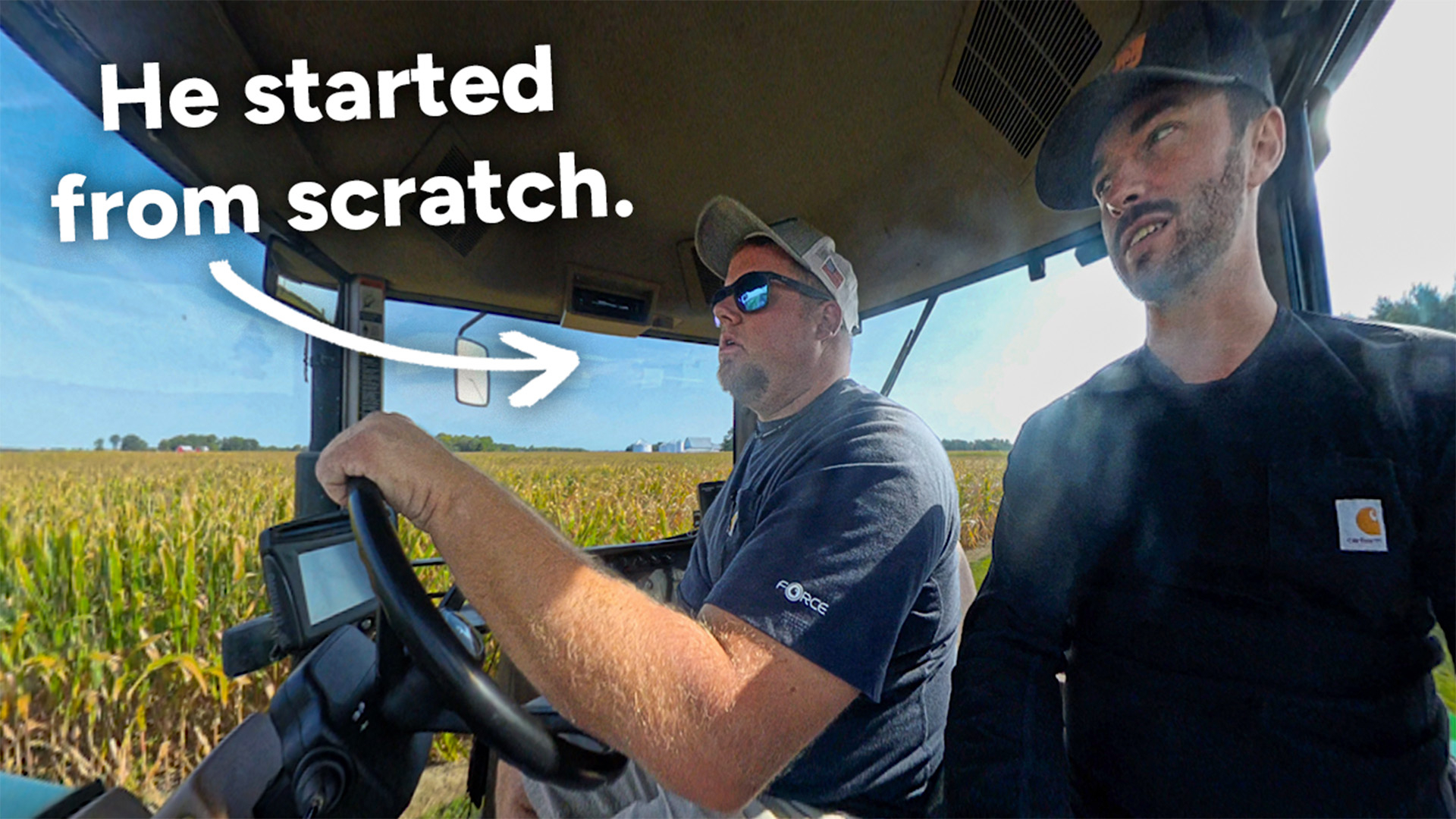
So, how many acres do you have currently? I farm around 800 acres. 800. So, you said you had 80 yet. I started with 80. How long ago was that? That was 2016. You said you're a skip generation farmer, so your dad and uncle, I think you said, just decided, I'm done with it. Your grandfather, I think it goes all the way back to 1912. 1918, my great-grandfather purchased this farm. My great-grandpa, my grandpa, they farmed. My dad and his brother, they just decided there was better ways to make a living.
They kind of grew up during the 80s, which I don't know if you've ever heard about the 80s farm crisis. Dane's dad and uncle giving up the farm life is not unique among their generation. In the late 1980s, the American heartland was brought to its knees by the farm crisis. After booming in the 1970s, when high grain prices and easy credit drove farmers to expand their land and borrow heavily, the bottom fell out. Interest rates skyrocketed, crop prices plummeted, and the value of farmland, once seen as a sure bet, collapsed almost overnight.
Families who had worked the same soil for generations suddenly faced foreclosure, bankruptcy, and the loss of their way of life. It wasn't just an economic crisis. It was a cultural one. A moment when the promise of the young American family farm, that symbol of independence and perseverance, seemed to die right along with the land it was built on. So, if anything, it was pretty courageous for Dane to actually get back into the family business. The reason I got started farming is, as a kid, I just loved, the machinery is what I think draws everybody in.
Everybody wants to be around a tractor, everybody wants to be in a combine, and then you actually start doing it. And it is probably one of the dumbest businesses to be in, because it's all up to the weather. It's not a get-rich-thing. It's not a very good business, but it's about the best way of life, I think. Growing up around all this stuff, being out in nature every day, that is what kind of keeps you around. With your crop, your 800 acres, what are you growing on all 800, and then who are you selling it to?
Yeah, so corn and soybeans, 50-50. Half of that 800 is corn, half of it is soybeans. I grow a little wheat. Everything we grow, I market through different elevators, different grain buyers. You call around. Who's got the best price? You do contracts throughout the year, or you sell it in the fall. So, I think I was looking up, that year of corn, that doesn't necessarily hit the dinner table. No. A lot of what I grow is number two yellow corn. That's what it's classified as.
A large percent of it goes into animal feed, and then from there, we eat the animals, but a lot of what the corn has produced goes into animal feed or ethanol fuel. There is white corn, there is waxy corn, there is all kinds of different varieties. The white corn, a lot of that goes into your chips, tortilla chips and stuff. There is sweet corn, which is the corn you go buy at the store and eat. That is a whole different thing of corn.
You don't let it get dried out. You go in and pick it at a certain moisture. Same with soybeans. Number two yellow soybeans is what they are classified as. A lot of that goes into bio... Fuel, I mean, soybeans are in a lot of products.
Before we got to the massive combines and tractors, we took a step back in time. Behind the fields, Dane keeps a small collection of antique farm equipment. They're relics from a time when horsepower actually meant horses. A quiet reminder that before farming became modern, it was personal, built by hand, passed down, and never forgotten.
I started off as like farm equipment and stuff, and I'm big into like western. So, it's kind of a cross between just antique farm equipment, just... Just stuff from the good old days, you know? I'm telling you, man, you can sell some of this back to Cracker Barrel. Yeah. After they did the rebrand. Yeah. Well, that's what somebody told me they were doing that way before any of this hit the news, and I'm like... Oh, so you knew? Yeah. Okay. But I was trying to figure out how to get a hold of them, because, like, what are they doing with all that stuff?
Oh, good point. Are they throwing it away? Are they warehousing it? Bring it on over here. But I'm out of space. Wait, so what's your favorite piece of all your... Oh, man. Honestly, my... My favorite piece is probably this wagon right here. I found it in the barn. This wagon was sold in Sheridan, early 1900s, at that Kirchhoff Olin Ore store. I'm a member of the local historical society. If my kids someday say, hey, we don't want this crap, we're going to sell it, that's the one piece that will be donated to the town or to the museum or whatever.
Today's equipment is faster, smarter, and more efficient, but it comes at a cost, because in modern farming, the challenge isn't just growing crops, it's finding a way to finance it. When I bought this, I got this for like three and a half percent interest. I bought this spreader truck last summer. I think it's closer to... 7%, just because the difference in interest rates. This tractor here is like 2.1. I've had some chances to sell that and trade it, but I can't.
Operating is what it costs to buy my seed, fertilizer, pay rents. That is what I operate off of, and that is about a $450,000 loan. So now I've got interest against $400,000. And what does interest look like on that? It's like 7.5%. Now, and when I first started, it was one and a half, and it was nothing. The inflation's really kicked in. So, inflation, like, I mean, we just talked about how guys are suicidal, like, feel so much pressure. You are directly affected.
Yeah. On top of inflation and high interest rates, farmers have also had to adjust to unstable markets due to Trump's tariffs. It's everywhere. Everyone's talking about it. I was curious to hear from an actual farmer what he had to say about it. So, we just ticked off India, right, with the tariffs. India went to China, and now India and China, who I always thought were enemies, are now working together on trade deals because Trump put the tariffs on India. So, now we just lost another grain buyer.
So, now beans may be trading for, let's just say, it's not, but let's just say $10. Well, now they just dropped to just, you know, say $9.75, so we just lost 25 cents. Per bushel on the board. Because there's less demand? Yeah, there's less demand, so that's how it kind of directly affects us. It looks like the government's going to cut checks again to farmers just to try to keep them going, and none of us really want that. Like, we're going to take it.
Like, we're not dumb, but that is not what any of us want. We don't want to be dependent on that, so that's why we're... And there I was. After one full morning of being on a farm under my belt, I believed I was ready. Just a simple man, ready to drive his tractor to go pick up some corn. Like Farm Simulator, but in real life. I was ready to take up the keys from Dane, fire up that John Deere. Start getting some corn.
Instead… Never use a grease gun? Never. Never. I was handed a grease gun. What you're looking for are these grease points. That snaps on the top. You should be able to click it on there. Yeah. Time pumps. Yep.
In a devastating logistical blunder, we had showed up about three weeks too early for harvest time. So, after a good morning on the farm, some hard work with the grease gun, wanted to take the boys out for lunch. They decided, it's time for me to have a Hoosier pork tenderloin sandwich. In 1908, a man named Nick Freinstein, a German-American restaurateur in Huntington, Indiana, is credited with creating the first Hoosier pork tenderloin sandwich at his restaurant, Nick's Kitchen. He took a slice of pork loin, pounded it thin like a schnitzel.
Breaded it and fried it golden, serving it on a bun instead of a plate. The Tenderloin Sandwich has become a small-town staple, showing up in diners, drive-ins, and lunch counters across the state. And to be completely honest, never sounded very appealing to me at all. So, I pretty much have avoided it since I moved to Indiana. Until now.
Yeah, this is no joke. This is really good. I've lived in Indiana for five years and never had one. You've never had one? No. Oh, man. My first time. Good. These are really good. Yeah, this is no joke. But that's what I'll tell people. Don't go to the fair to get a temple. You'll get one of those press ones. Okay. Yeah. You've got to go to a place like this to get a real good one.
Dane texted me three weeks later and invited me out to do this farming thing for real. My only request is that my son could experience the same thing that he did many years ago, and come out and join for Harvest. When I sat down in the combine with my son and Dane, I couldn't help but appreciate the look on both of their faces.
My son's wide-eyed awe at such large machines, and Dane's simple satisfaction of collecting his reward from months of hard work. The fields that I drove by all year were no longer just horizon decoration. They were someone's livelihood. And although the technology may have changed, there is something very human about the connection to the land, the food that we eat, and the humility and trust required in this profession. Now, it's more than a profession.
It's a way of life. A way of life I'm grateful to have gotten a peek into. I made a local friend, the world feels a little bit smaller, and who knows, maybe my son will catch the ag bug one day.
If I'm in the combine, and the sun's setting, it's a beautiful night, I'm bringing in a crop that you put the seed in the ground, and you spray it, and you fertilize it, and take care of it, but everything else is out of your hands. That will bring you close to God about as much as anything else, I think.