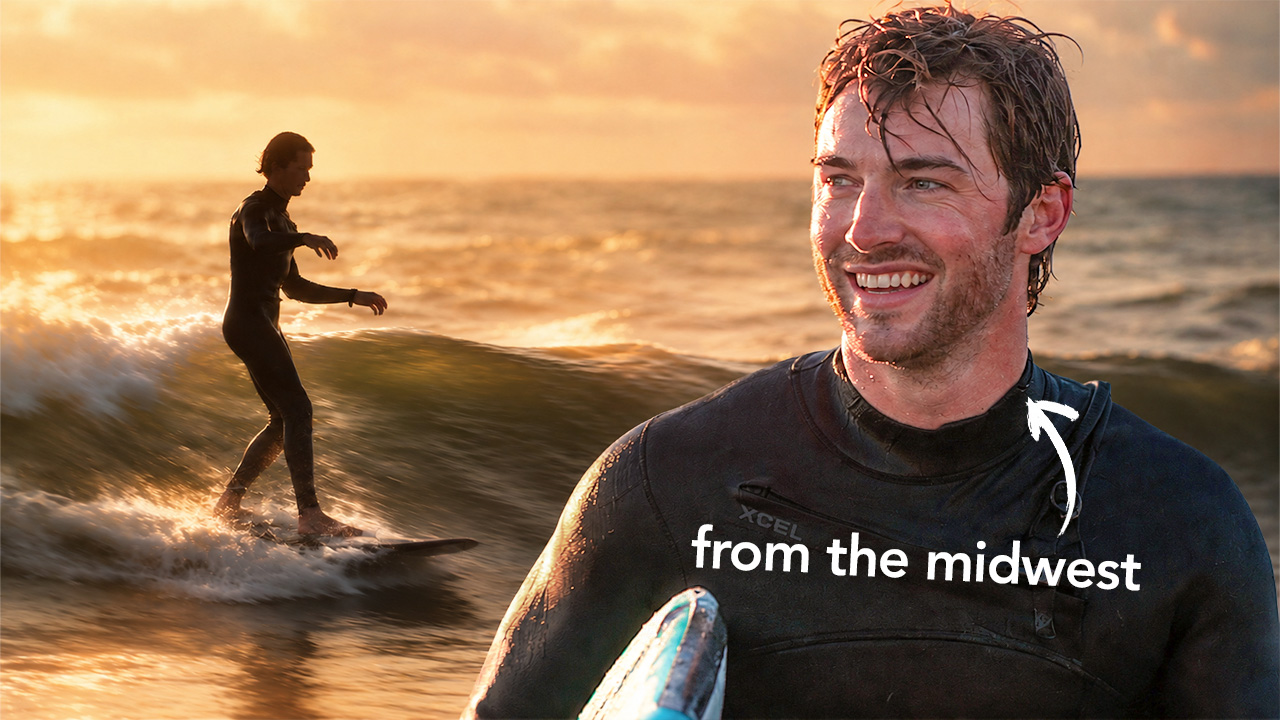
I Thought Surfers Were a Stereotype. Then I Became One.
In this episode of Tom Across America, I travel from the Midwest to Southern California to investigate surf culture. With help from locals, board shapers, surf shops, and a few humbling wipeouts, I try to understand what makes surfing such a powerful part of California’s identity. Is it just a fun hobby… or does life next to the ocean actually change the way people see the world? Watch as I become the thing I thought I understood: a surfer.
Transcript
Read the full transcriptAuto-generated · 2,799 words
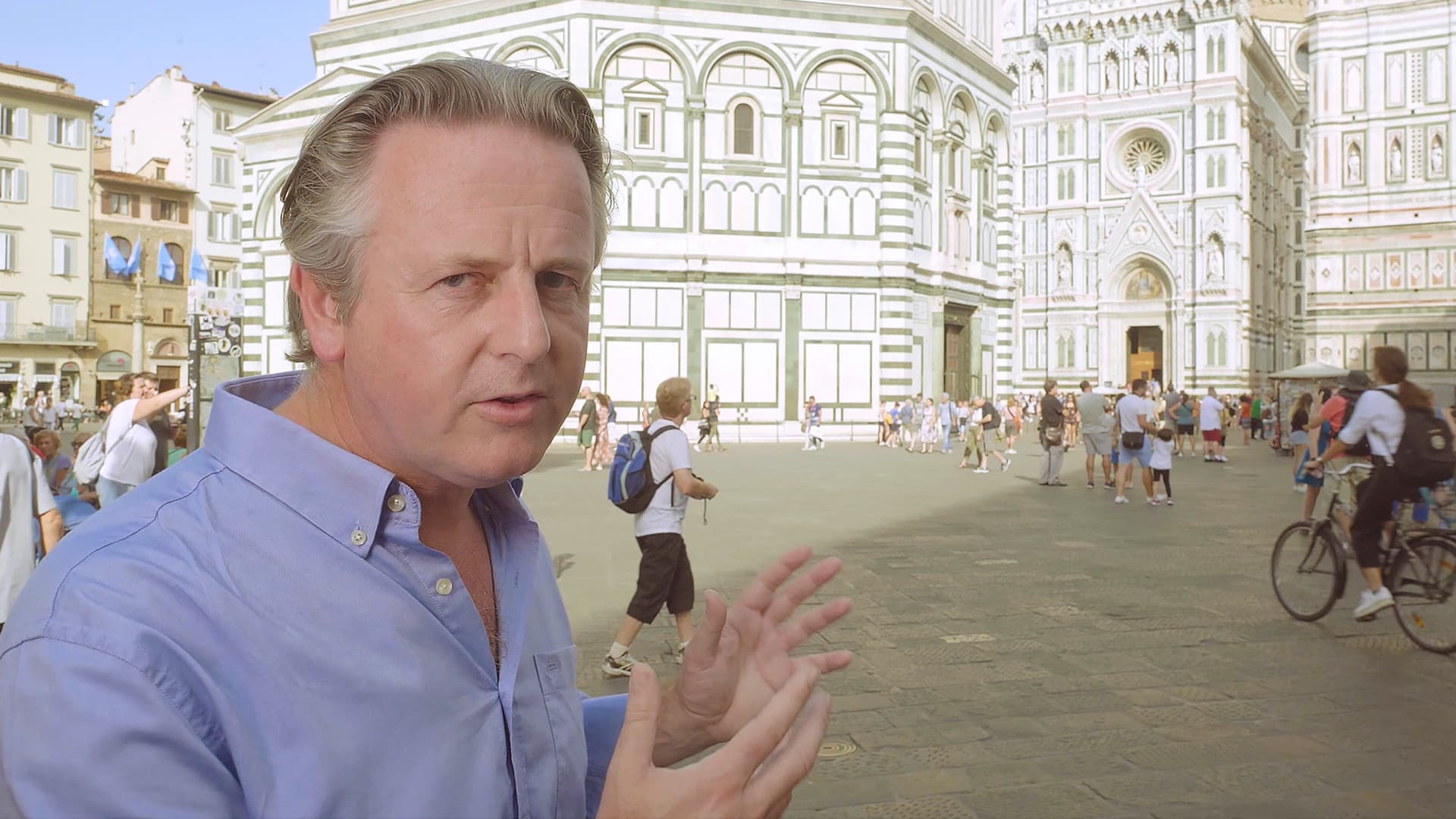
Surfers. To a guy from the Midwest, they almost feel like mythical creatures. A meme, a character from a movie, something from a Beach Boys track. Perpetually tan, carefree, and somehow always barefoot. Just gliding across the Pacific like it's a perfectly normal way to spend a Tuesday morning. Where I come from, the ocean is not a part of everyday life. So, if I was ever going to understand surfers, I couldn't do it from Indiana. I had to go where surfing is not a vacation activity, but a way of life.
How do you identify the right spot for when a wave is coming that you can ride? You just feel it in your nuggets. Today, I'm stepping into the world of Southern California surf culture to see what I can learn from the ocean, from the locals, and from repeatedly getting humbled in public. And I figured out firsthand, are surfers just people who have turned avoiding responsibility into a lifestyle, or do they know something the rest of us don't? Is this actually your first time setting foot on Pacific Ocean sand?
First time on Pacific Ocean sand, and it will be the first time on the Pacific Ocean. What do you think? What's your first reaction? It is pretty big, dude. Hey. Guru has arrived. All right. Doesn't this guy look like California? Yeah. Yeah, you look like . I have never seen him in California before. Good to see you again. Good to see you. All right. We decided we are calling you Big Z. Oh, yeah. You are Big Z, dude. Okay. And Tom is going to be Chicken Joe.
Yeah. I am Chicken Joe. And Tom is going to be Chicken Joe. Okay. See you guys today. I'm going to try to help us live out that movie as much as possible. That's the goal, dude. I learned the first challenge of surfing is putting on the wetsuit, especially if you do it the way the locals do. So, I get totally commando. Dude, okay, yeah, I'm hearing about this. So, up to you. You can imitate me. I do want to. I want to do everything you do.
Okay, so what you want to do is grab a little towel here. Okay. Wrap it around your body as such. Very carefully. And you don't need the censor or anything, that's because of the towel wrap. If the video cuts, we know why. Yeah, right, yeah. Oh boy, this is a risky maneuver.
Alright, there we go. And I'll do that with the other leg. Oh boy, okay. I think my cheeks are in your truck right now, bro. I'll never wash it again. I got Tom Across America's Cheeks imprinted on my vehicle. Do you want me to sign it or something? Sure. Give you a little autograph there, yeah. Okay, there we go. There you go. Yeah, you just want to hike them up. Let's go, dude. I think we're good. Oh yeah, dude. Oh yeah, dude.
Wow. We are going to have fun, I know it. It is going to be awesome. So, where you want to be when you are catching the wave is you want your feet kind of at the end of this board. When the wave is coming behind you, you want to already be paddling going forward, and then once you feel the wave kind of pick up and start pushing you, you are going to first go into this kind of seal position, then you would go to one knee, and then from there, you are going to keep your butt down and your chest up, and you are going to get to your feet, and if you feel like you are dragging, you can shift forward.
Go ahead and give it a try. Right there, and then you are paddling. The wave is coming, you are paddling, and now you feel the wave push you, so you are going to go seal, seal, seal, and then bring my right foot up, right foot up, and then, perfect. Now, there are a few other things we have got to go over here. So, we have this little armory surfer guy. That is me. That is Tom. We are going to make a little wave here.
Alright, so here is Tom and the waves behind him, right? So, he is going to be paddling. And then when it picks it up, the wave is going to be opening up on one side, and what you are going to do is you are going to turn towards, and you do not want to be too far down here, because then you are out of it. You want to stay right in the curl. So, you are sort of hugging the center line.
This part will break. Surfing is also about having fun. Of course. So, you have got to show me some excitement, okay? So, you are going down, you smack the little, whoo-hoo, you blow the tail out. So, show me that. Show me how you do it. Yeah, yeah, yeah.
All right, that's pretty good, but I need more joy. Okay, more joy, more joy, okay. Surfing is about joy. So, listen, you can't see it, but the green smile on his face is really big at this point. And it's growing, it's expanding. Okay. Catching the wave, he's getting barreled, dude. All right, show me, show me.
Are you ready to get in? I'm, dude, I'm pumped. I think you're ready. Tom, there's also something called the Stingray Shuffle. Okay. So, when you're touching the seafloor, you're going to want to just shuffle your feet. Okay. Instead of stepping. Okay.
So that you don't step on any stingrays. Okay. Tom, I think you can start paddling if you want. Yeah? Yeah, yeah, yeah. And then when the wave, when you reach the wave, go to your seal position, but stay pointed straight at it.
Yeah. And then paddle again right after. My first surf session was complete. The learning curve was steep, and I had taken my lumps, but I still had a huge smile on my face. After loading up the boards with hungry stomachs, we made a stop for the quintessential Southern California fast food experience.
Okay, we're at In-N-Out. Tom is at In-N-Out for the first time. So, the menu is simple. Basically, you get a burger. You can get a cheeseburger or a hamburger. A double-double is just two patties. You can also get a three-by-three or a four-by-four. And then there's something called animal style. This is his first time at In-N-Out. He's from Indiana. Your mind is about to be blown. Can I get one of the hats, too, when you have a chance? Like being crowned.
Yeah, you're getting crowned in In-N-Out. All right, so these are your points. First, by ranking it on the boom meter, as I always do. I can't believe this is happening. It's five big booms. That's five big booms. Let's go.
I was loving California so far, but in order to fully appreciate it, I wanted to go deeper. Who is crazy enough to try riding waves in the first place? Fortunately, another Tom was happy to guide us at the California Surf Museum to bring us up to speed on the rich history of surfing. I started surfing in 1965, so this is my 61st year in the water, and still as excited as ever about it, and it's hard not to be when you get to be around this all the time.
Oh, gosh, yeah. Yeah, I was on one half of a wordy surfboard in 1965 and learned that was probably in Newport Beach, as I recall, 39th Street. I got planted. I asked my mom if I was bleeding, and apparently I wasn't, and I've been surfing ever since. As far as modern history, it's generally accepted the Polynesians when they settled the Hawaiian Islands in around the year 1000. They brought surfing tradition with them, and at that point, it seems like surfing didn't migrate for like 800 years, and then you come to 1885, and Prince Cahill and his brothers, they're vacationing in Northern California in Santa Cruz because they're attending school up in San Mateo, and they decided to go surfing, so they had a miller fashion them some boards out of redwood.
These are actual replicas of two of the three boards Prince Cahill and his brother had, and these each weigh about 250 pounds. It took six of us Put them on here. How does it kind of get its evolution, I guess, here in Southern California? When I think of surfing, I think of Hawaii, certainly, but I definitely think of this area of California. George Freeth introduced surfing in 1907 in Southern California, and he was hired by Henry Huntington, like Huntington Beach, that name, because Henry Huntington owned all this.
Coastal property. So, he hired people like George Freese to show people how much fun they could actually have if they might want to live at the beach. People like Duke Kahanamoku were regulars in Southern California by the 1920s. He had gone around the world after his first of his Olympics in 1912, spreading the Aloha. By the early 20s, people were certainly surfing in California, and Duke was considered quite a regular in the Newport Beach. Corona Del Mar area in the early 20s.
We have one of his boards in our timeline from that period, circa 1923. The significance of this board is he changed both surfing and lifeguarding history because he performed a rescue in high surf, and he saved eight fishermen. Wow. It was June 14th, 1925. Surfing didn't grow up in a bubble, so you can see the changes over the decades, reflective of the technologies and the boards.
Yeah. The materials. Fortunately, we don't have to ride big wooden boards anymore. We popped over to Cardiff Surf Company and met Jay to learn more about the craftsmanship of what people ride today. So, my name is Jay Greger. We're in our family surf shop, Cardiff Surf Company, and we're in Cardiff-by-the-Sea, California. We make our surfboards here in-house. So, my dad shapes the boards. I used to do all the glassing, but now I just work here at the store, and we still make a ton of custom surfboards.
So, this is all custom-ordered, custom-made, specifically for him. I like the little heart on the back. Yeah. So, the heart is for the model of the board. Okay. So, that means the shape. So, my dad shaped this board. Okay.
This blank was custom-ordered for, this guy's name is Ken. From the very beginning, he came in, we wrote up an order form, we ordered him the blank from U.S. Blanks, it's called a T-band stringer, so if you look, you have actually three pieces of wood all glued together, so you have dark wood, balsa wood, and then dark wood again, so it's three pieces of wood all glued together. So, this board is made for small waves, so he wanted something that was going to be...
The board is going to be stable and also give good flotation. So, because of, you know, he's going to be surfing this board when the waves are small, he'll be able to catch waves easily. But you can see right here, like the board you rode yesterday was a tri-fin setup, so three fins. Yes. This is a single fin. Okay. So, only one fin, and you're going to use one big fin in this board. This would be something kind of retro to where you could ride...
During small surf, but it is going to have good flotation. This is called a fish. So, you can see this board right here is designed to only run two fins, twin fin. Let me go grab a fresh bar of wax real quick.
So, wax is based off of the water temp. So, like the water right now is 65. This is cool water wax. It is 58 to 68 is the range. So, this would be like your top coat, your sticky coat. So, every time you go surf... What does the wax do when you surf? It makes it sticky so you don't slip off the board. So, like, if you rub your hand right here, like, imagine water on that, too. Like, it'd be all over the place.
And then this is... This gives you your attraction. So, you feel it's like, it's sticky to the touch. So, what you do is, like this board, you wouldn't wax this one all the way to the nose. This board would be more like three quarters, but so I kind of hold it like sideways on an angle. You just want to do like circles. You don't have to push very hard, but you can just, right away, you can just see it's like sticking to itself.
Oh, yeah, nice. Yeah, natural. This is just continually trying to get into surf salt mode. Yeah, yeah. After the greatest fish tacos of my life, we stopped to observe some surfers at Carlsbad Beach hoping to pick up some tips. I was blown away by the talent of the average surfer in the water on a random Tuesday afternoon. As I watched, I frantically took mental notes that would hopefully help me have a successful final surf session.
And then suddenly, it happened. I caught that one magical wave. In this moment, everything faded away, and I really felt like a surfer. I knew exactly what everyone had been talking about. What has surfing taught you about life? To be patient.
To wait for that good wave, don't be chasing ones that are less good. One might even look good, but you know a good wave when it is coming. So, I think just not chasing after everything that comes your way. Also, just being present, sitting in the present moment, practicing the present moment. I do some of my hardest praying in the water. I do some of my best thinking in the water, because it puts you in the moment, absolutely. And just the notion of writing something as organic as kinetic energy, and that is just rolling kinetic energy.
It is a rolling barrel of energy that was created by wind, maybe 5,000 miles away. And it also seems like it is not really up to you. You cannot create a wave. The wave comes to you. It is a different. That's why surfing is that metaphor for life. It's humbling. It teaches you humility, patience. It just makes you wait for your gratification sometimes. It's hard work. It's just like life. But it's so worth it, you know, at the end of the day.
You're hanging out with your family and it feels like this is something that really just brings families together. It brings friends together. Do you feel like it's really bonded you and your family? Oh, yeah. We all love it. I think that shared love for, you know, a pack... Picking up the minivan and getting to the beach and spending the day together, and all of us really loving it, that absolutely ties us together. So, I think if you can share the joy of surfing, of going to the beach, going anywhere with your family, that is something you want to hold on to.
That is really precious. Now, I am passing that on to my kids. Yeah, what is that like? Well, they are 8 and 10. I have got two boys. I have had them in the water since they were two years old. But now, I am teaching them how to surf and just be safe in the water, you know? Super fun. You know, people's backgrounds just kind of fade. I'm blessed in my own private surfing group to surf with people from all walks of life.
What is unique to the people of Cardiff or Southern California? Just the outdoor lifestyle. Yeah, being outside surfing, whether you're just walking around, just being outside enjoying the good weather. You just can't beat, I think, just that feeling we have now of having come out of the water, you feel the salt on your skin, a nice breeze, that sunshine is coming down. It just feels incredible.
Are you going to move out here, Tom? Are you going to stay, or are you going to keep? I got to go home to my wife and children, man. I love them and miss them too much. Oh, bring them too.